Product Overview
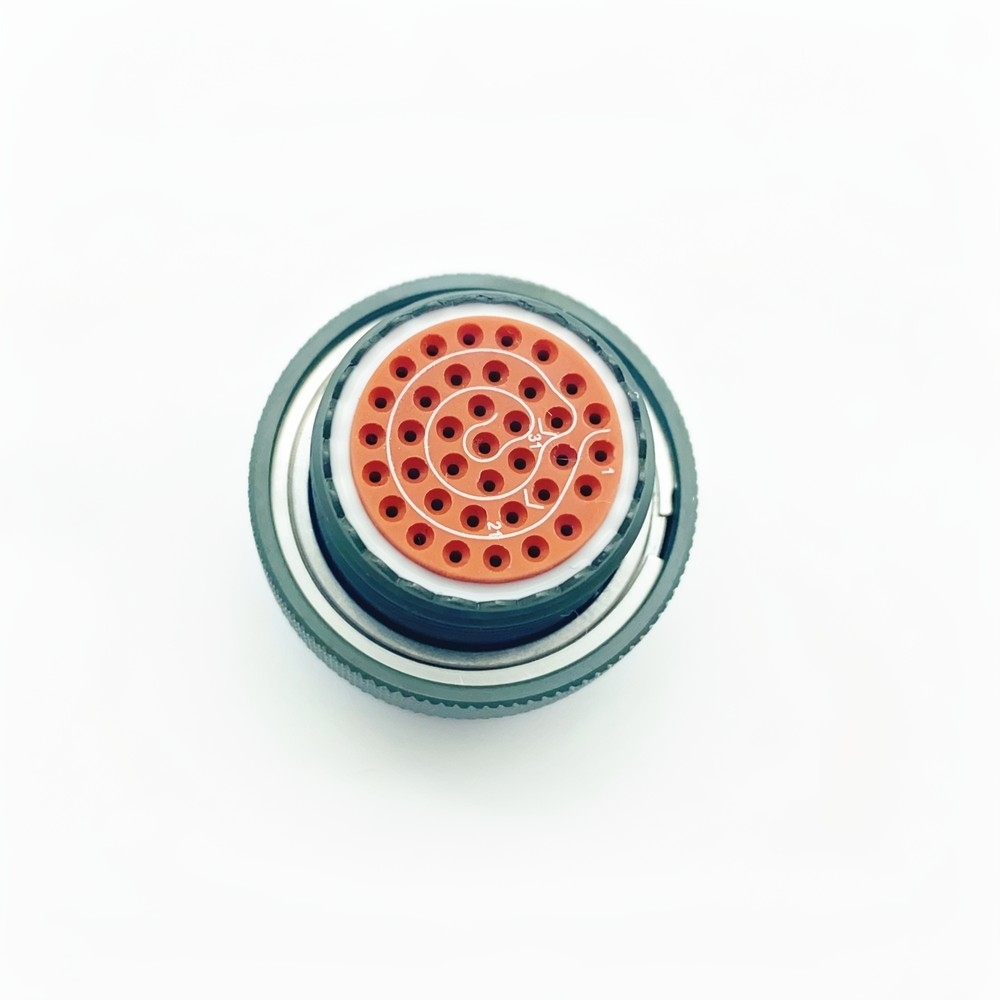
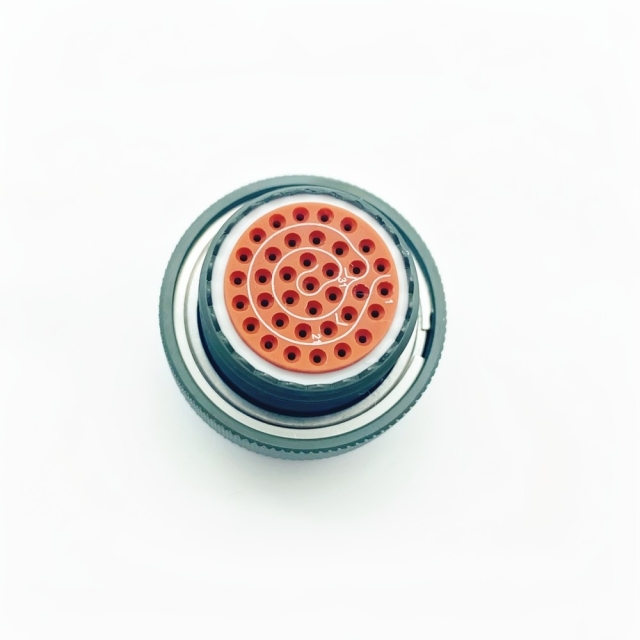
The MS27484T14B35S connector is a shielded plug from the MIL-DTL-38999 Series II family, built on a shell 14 body with a high-density insert and a threaded coupling ring. It is the cable-end half of the connection: the ring draws the plug onto the matching Series II receptacle, and the shielded body carries the screen through the shell instead of leaving the cable assembly to find its own ground path. Light weight and contact density are the two practical reasons this shell appears so often on aircraft and satellite systems. A shell 14 plug carries a useful circuit count without the bulk of a larger can, which matters when a cable assembly has to pass through a crowded avionics bay or run along a structure where every gram is counted and every few millimetres of bend radius is fought over. The coupling carries the mechanical story. The threaded ring pulls the plug home and keeps it there, and the keyed insert stops the contacts meeting in the wrong orientation. Together they make this a vibration resistant circular connector that stays seated on a moving platform, and they let a technician confirm seating by hand before the circuit is energised. Because the plug is backward-compatible with legacy Series II infrastructure, existing receptacles, backshells and assembly tooling stay in service. A platform can take this connector without a redesign at the panel end, which is usually the expensive end. As a direct manufacturer of military-grade circular connectors, we remove middleman markups to offer competitive volume pricing for aerospace and defense procurement. We support flexible order quantities and stable global delivery to keep your supply chain on schedule.
Part Number & Cross-Reference
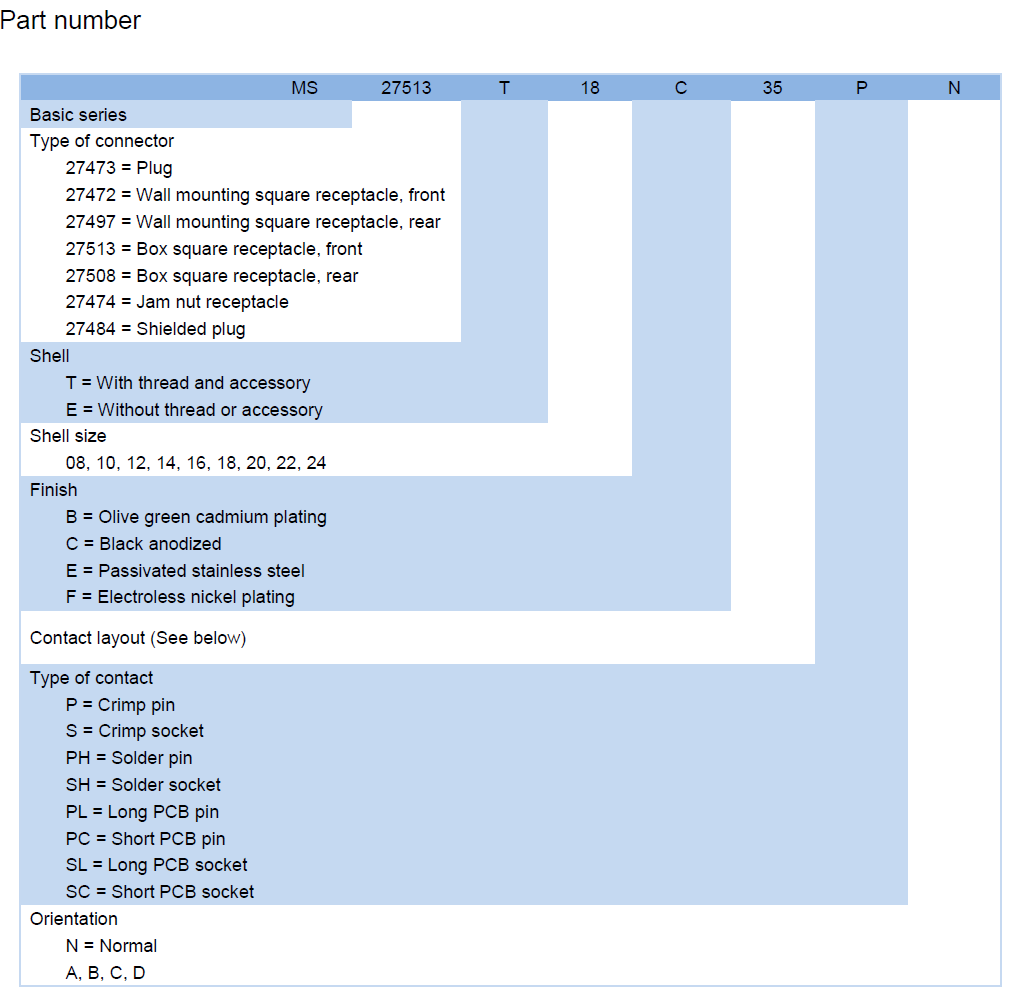
| Model reference | MS27484T14B35S connector |
| 27484 | Shielded plug |
| T | Threaded coupling with rear accessory |
| 14 | Shell size 14 |
| B | Olive green cadmium plating |
| 35 | Contact layout |
| S | Crimp socket contacts |
| P / PH | Crimp pin / solder pin |
| SH | Solder socket |
| PL / PC | Long / short PCB pin |
| SL / SC | Long / short PCB socket |
| C / E / F | Black anodized / passivated stainless steel / electroless nickel |
| Shell range | 08 to 24 |
| Cross-reference | BACC63 and EN3645 compatible |
Advanced Contact System
- Gold-plated contacts. The plating keeps contact resistance low and holds corrosion at the interface, which is where a connector usually starts to fail.
- Polarised keying. The insert accepts the plug one way only; N is normal keying and A, B, C and D are alternates, so several connectors can sit side by side on a panel with no chance of a wrong plug-in.
- Contact options across the range. Crimp pin and crimp socket (P and S), solder pin and solder socket (PH and SH), plus long and short PCB pins and sockets (PL, PC, SL, SC).
- Serviceable crimp joints. Crimped sockets can be reterminated on the bench with standard tooling, so one damaged circuit does not scrap the shell.
- Contact retention. Contacts are positively retained in the insert, which is what keeps a vibration resistant circular connector connected when the platform shakes. A contact that walks back in the insert is the start of an intermittent fault.
- Electrical behaviour. Contact geometry keeps impedance stable and insertion loss low, and the shell provides EMI shielding for signal and low-power runs.
- Heat at the interface. Gold over the contact body holds resistance steady in a high temperature military connector envelope; the current derating for your cable assembly should follow the contact layout you specify.
- Made in-house. As a MIL-DTL-38999 connector supplier, we form and plate the contacts and build the shells ourselves, so plating, keying and contact options are matched to the cable assembly rather than picked from a catalogue of one.
Sealing & Environmental Protection
The plug seals at three separate places, and each one has a different job. The environmental seal sits at the mating interface and closes the gap between plug and receptacle before dust or water reaches the contact chamber. Rear wire seals close around each individual wire as it leaves the insert, so moisture running along a cable bundle cannot creep into the back of the connector. Body seals close the shell itself. Together they make this a waterproof MIL-DTL-38999 connector in the mated condition, which is the condition that matters on a washdown deck, an airframe skin or a splash zone. The materials are chosen for the same environments. Fire-resistant materials compliant with MIL-STD-810 for flame retardancy are used in the assembly, a requirement that appears in most aerospace circular connector OEM specifications and one that a commercial-grade shell rarely meets. Salt-laden air is the slower opponent. Keeping a salt spray resistant connector reliable is not only a question of what the shell is plated with; it is a question of keeping electrolyte away from the contact interface and away from the crimp barrels. That is what the seal stack does while the plug is mated, and what a protective cap does while it is not. Most field failures start at a seal rather than at a contact. Keep the interface covered while the plug is unmated, check the seal lip for cuts and grit before every mating, match the wire diameter to the rear seal, and replace a damaged seal instead of reseating it. A seal stretched by oversize wire will pass a bench check and fail in service.
Target Applications
- Aerospace. Avionics bays, flight control runs and engine monitoring cable assemblies, including positions close to the engine core where a high temperature military connector is needed rather than a commercial shell.
- Satellite and spacecraft. Light weight and high contact density suit launch-loaded cable assemblies and payload electronics where the mass budget is tight and the envelope is fixed.
- Military. Radar systems, tactical vehicles and communications equipment, where the plug is mated and unmated by people in gloves, in poor light, on a schedule.
- Marine. Submarine systems and naval vessel electronics, including deck and hull runs that see salt air daily — the sort of position where a salt spray resistant connector earns its keep.
- Industrial harsh environments. Test rigs, actuators and outdoor control cabinets that see vibration, washdown and temperature swings without salt water.
- OEM programmes. Builders running aerospace circular connector OEM programmes use this shell as a common interface across several sub-assemblies, so one plug, one backshell and one set of tooling covers more than one cable assembly.
Performance & Qualification
| Standard | MIL-DTL-38999 Series II |
| Coupling | Threaded |
| Vibration | 10–2000 Hz |
| Shock | 100 G |
| Mechanical impact | Included in Series II mechanical robustness testing |
| Sealing | IP67 when mated |
| Operating temperature | -65 °C to +200 °C |
| Salt fog | Corrosion resistance |
| Shielding | EMI shielding, stable impedance, low insertion loss |
| Qualification | Environmental, mechanical and electrical testing to Series II requirements |
Field Service & Coupling
- Start with an inspection. Check the keyway, the seal lip and the contact ends for grit, cuts or bent sockets; two minutes here saves a cable assembly rebuild later.
- Align the key and start the coupling ring by hand. A plug that will not drop onto the receptacle has a keying mismatch, not a stiff thread, and forcing it damages both halves.
- Thread the ring down until the plug seats fully. The thread holds the plug home under load and the keyed insert holds the contacts in line, which is what makes this a vibration resistant circular connector rather than a push-fit one.
- Confirm seating before the circuit is energised. Seating is felt and seen at the ring, not guessed from a meter reading.
- Disconnect with the same hand action. The quick-disconnect coupling is made for field servicing, so a technician can pull a box or a panel without cutting the cable assembly.
- Use the colour-coded inserts when several connectors share a panel. The colour is there to shorten assembly and troubleshooting, and it is worth keeping the same convention across a platform.
- Log the mating and inspect seals at scheduled intervals. Seals are the wearing part; replacing one on the bench costs a fraction of tracing an intermittent fault in service, and that is where most of the downtime saving sits.
- Keep a small spares kit. The working life of this plug is decided less by the contacts than by what reaches the seal lips and the gold plating between services. A short routine, run at the same interval as the platform inspection, prevents most of the failures that later get blamed on the connector. Cleaning the contact ends Wipe the plated contact ends with a lint-free cloth dampened with isopropyl alcohol, and let the solvent flash off before the coupling ring goes back on. Keep abrasive pads, wire brushes and contact files away from the interface: they cut through the gold and leave nickel or copper showing, which is exactly where corrosion begins. Stay away from ketone and aromatic solvents around the insert as well, because on a waterproof MIL-DTL-38999 connector the seal stack is elastomer and those solvents attack it even when the contacts survive. Seal lips and coupling thread Lift dust and salt deposits out of the seal grooves with a soft brush and clean water, then blow dry with low-pressure air. Clean the coupling thread in the same pass — grit in the thread makes the ring feel tight long before the plug is seated, and a technician who keeps turning on a gritty thread is how keyways and seal lips get damaged. Lubrication Leave contacts and seals dry unless your assembly procedure names a specific compatible lubricant. Grease on a seal lip holds grit against the surface and turns a routine wipe-down into a slow lapping action; where a drawing does call for lubrication, use the named product and the stated quantity only. Retention after retermination After replacing a contact, push it lightly from the front to confirm it has locked into the insert, and check that the rear seal closes around the new wire. A contact that shifts under finger pressure is not seated and will walk back under vibration; use the correct extraction tool rather than a probe, because a distorted insert cannot be repaired. Inspection interval and records Note the cleaning date, the seals replaced and an approximate mating count alongside the cable assembly. A salt spray resistant connector on a deck or hull run usually needs attention more often than the same plug in a dry avionics bay, and the log lets you set the interval from real service rather than from a calendar. What cleaning cannot fix Corrosion inside the contact chamber, a socket with relaxed tines, or a seal that has gone hard are replacement jobs. Because the plug is built for field servicing, those parts can be changed at the bench without scrapping the shell or cutting the cable bundle — but only if the fault is caught at inspection instead of at a failed system check.
Ordering & Delivery
- Quote the part number in full — the MS27484T14B35S connector plus any change of finish or contact code. One character changes the part.
- Confirm the mating half at the same time. Receptacle, spare contacts and rear accessories can be quoted together, which avoids a second shipment later in the build.
- Ask for the current model list. Not every shell and contact layout is listed in our web catalogue, and the full selection table is the reliable reference.
- Documentation. Every connector is traceable, and as a MIL-DTL-38999 connector supplier we issue a certificate of conformance and test reports to support incoming inspection and programme records.
- Price and quantity. We work to flexible MOQs, and because the connector is built in-house as a Series II circular connector manufacturer, pricing is direct from the factory without a middleman markup.
- Delivery. Stable global delivery keeps production and spares schedules on track; confirm the shipment schedule for your quantity with your sales contact.
- Custom configurations. For a special contact arrangement or a cable assembly build, send the drawing to our technical team before the order is placed.
- Payment and shipping terms. Confirm the payment method and the shipping terms with your sales contact when the quotation is issued.
Technical Support & Model Matching
Selecting the right connector is rarely a one-line decision. Send us your drawing, part number or a sample, and our engineering team will confirm the matching shell size, contact arrangement, coupling and mounting style, cross-reference discontinued or alternate part numbers, and advise on sealing and flange options for your environment. We also help troubleshoot fit, mating and signal problems, and give installation and commissioning guidance so your line stays up. As a direct manufacturer, our answers come from the people who build the parts — from first enquiry through after-sales support.
FAQ
Which Series II receptacles does this plug mate with?
It mates with the Series II receptacle that shares its shell size and contact layout — the 35 layout in shell 14 — and the keying has to match as well. Send us the receptacle part number or the panel drawing and we will confirm the mating pair, the keying position and the rear accessories. A plug from a different shell size or layout will not seat, and forcing one damages both halves.
Does the plug cross-reference to BACC63 and EN3645 harnesses?
Yes — this part is documented as compatible with BACC63 and EN3645, which is what you need when a drawing quotes one of those references while the stock part carries an MS number. Because we build the range as a Series II circular connector manufacturer, we can check the cross-reference against your cable assembly drawing and confirm that the shell, layout and contact type line up.
Can it be used on satellite and high-altitude payloads?
The connector is built for aircraft and satellite systems: the shell 14 body keeps mass down and the high-density layout packs the circuits into a smaller envelope, both of which count on a launch-loaded cable assembly. For a specific aerospace circular connector OEM programme, confirm the qualification documents and any screening your customer requires with our engineering team before the cable assembly is released, because programme requirements differ.
How should the contacts and seals be cleaned between service intervals?
Use a dry, lint-free wipe on the contact ends and a soft brush around the seal lips, and avoid solvents that attack the elastomer. Check that the waterproof MIL-DTL-38999 connector interface is completely dry before the plug goes back on, because trapped moisture under a seal is worse than no cleaning at all. Bent sockets, cut seal lips and corrosion bloom on the plating are the three things to look for, and any of them means a replacement contact or seal rather than a clean-up.
How does the connector behave in high-temperature zones?
The insert, seals and plated contacts are chosen for the heat a high temperature military connector meets around engine monitoring, actuator and exhaust-adjacent runs, and the assembly is rated across the Series II temperature envelope. What limits a cable assembly in practice is usually the wire and the backshell rather than the connector body, so check the cable specification and the strain relief before committing to a route close to a heat source.
What should I check if the plug has been stored or used in salt air?
Look at the shell plating first, then the contact ends and the seal lips. A salt spray resistant connector keeps electrolyte away from the interface while it is mated and sealed; the risk period is storage and transport, when the plug sits unmated. Keep the interface capped, store the plug dry, and clean and inspect it before service. Surface bloom on cadmium plating is a cleaning job; corrosion inside the contact chamber is a replacement job.