Product Overview
What this part is
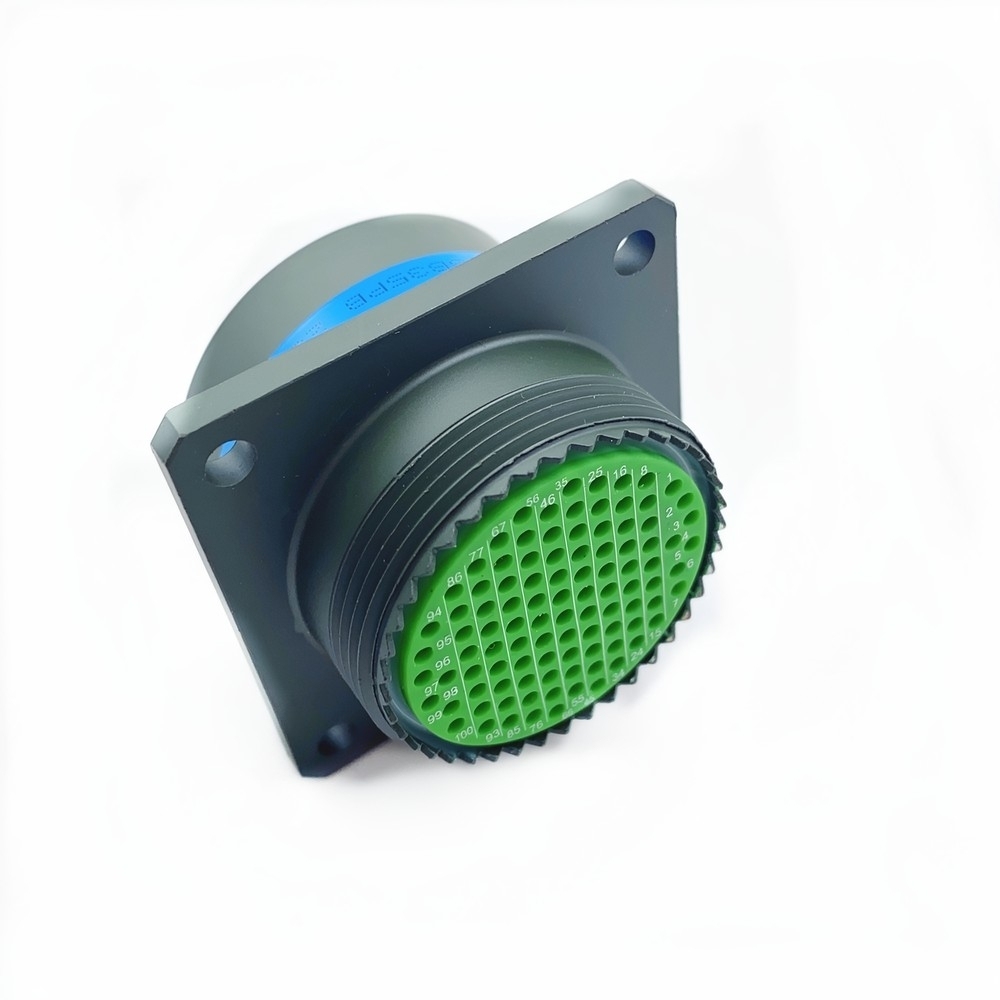
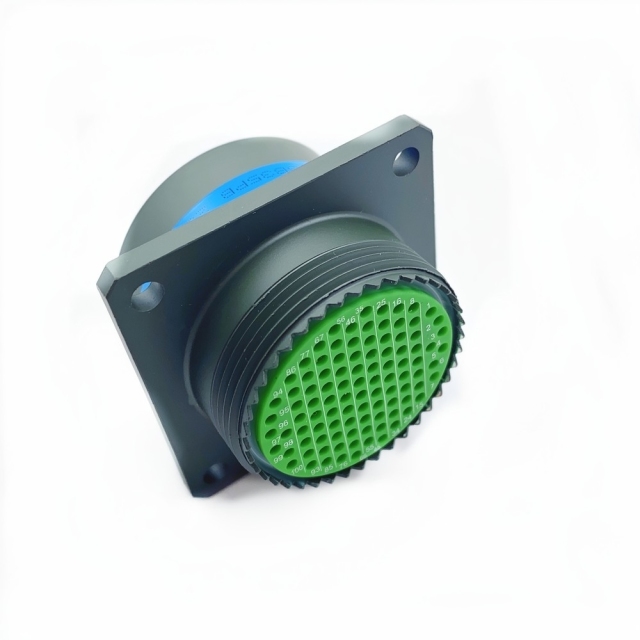
The MS27466T23B35PB is a wall-mount MIL-DTL-38999 Series I connector: a square-flange receptacle with a shell 23 body, a 35-way contact layout and crimp pin contacts. It mounts through a bulkhead or panel from the front, with the flange flat against the mounting face and four screws holding it there. Behind the flange sits the threaded accessory interface that takes a backshell, strain relief or conduit, so the cable side is finished the way the cable drawing calls for. How it fits into a build This is the panel half of a plug and socket pair. The receptacle stays with the equipment; the mating plug travels with the cable. That split is what makes the part practical on avionics racks, junction boxes and vehicle cable runs — the fixed side is keyed and sealed to the panel, and the removable side carries the service loop. Stocking the two halves separately also means a damaged cable end can be replaced without opening the enclosure.
- Square front-mount flange — the four-hole flange seats flat against the panel face, so the receptacle is fitted and tightened from outside; nothing has to be reached behind the bulkhead, and four fixing points are what keep a vibration resistant circular connector seated on the panel.
- Threaded rear interface — the T code gives the back of the shell a thread for a backshell, strain relief or conduit, which means the cable bundle is clamped and finished before the connector goes into service.
- Numbered contact cavities — the insert carries numbered positions, so crimping, circuit identification and fault-finding stay manageable on a 35-way layout.
- Crimp pin contacts — the P code means crimp-terminated pins rather than solder cups; contacts are crimped with standard tooling and inserted, which suits repeat builds and field repair.
- Alternative B keying — the keyway is offset from the normal position, so two connectors of the same shell size can sit side by side without being cross-mated.
- Receptacle half of the pair — as the panel side of an aerospace circular connector plug socket pair, it lets a workshop stock fixed halves and cable halves separately and match them at build time.
- Suffix-driven variants — plating, contact type and keying are carried by the characters after the shell size, so specifying a custom mil-dtl-38999 connector for a program is usually a matter of choosing suffixes rather than starting a new drawing.
Military-Grade Reliability
Standards alignment
As the mil-dtl-38999 connector manufacturer, we build this range to the Series I drawing, and the qualification routine behind it covers mechanical endurance, electrical continuity and environmental exposure rather than appearance alone. Salt spray sits inside that routine, which is why the shell finish and the contact plating are fixed by the part number instead of being left to a general description. Every connector is checked for environmental sealing and high-vibration performance before it leaves the line, and that discipline is what keeps long-term maintenance cost down: a part that does not corrode or drift does not generate repeat work orders. Heat and long service The part is built for the top end of the temperature envelope, which is what separates a high temperature circular connector from a commercial shell wearing a military label. Thermal cycling is the harder duty: shell, insert and contact retention expand at different rates, so a connector that survives a soak test can still drift on contact resistance after a few hundred cycles. Crimped contacts and a threaded coupling are what keep that drift small.
Superior Signal Integrity
- Controlled contact geometry — consistent spacing through the insert holds impedance steady and limits crosstalk between neighbouring signal paths.
- Low insertion loss — this is what makes the part usable up to 3 GHz in RF chains and for high-speed data, not only for power and discrete signals.
- Shielding that depends on the backshell — a metal shell and a conductive finish give interference somewhere to go, but on an aerospace circular connector plug socket the path is only closed when the rear accessory is properly terminated and bonded.
- Repeatable crimp terminations — a crimped pin is more consistent than a hand-soldered cup, so insertion loss does not vary from one cable build to the next.
- The assembly, not just the part — signal performance on a MIL-DTL-38999 Series I connector is a joint property of contacts, insert and cable termination; if your link budget is tight, send the cable specification with your enquiry and, as a military circular connector supplier, we will review the assembly as a whole.
Environmental Resilience
Sealing belongs to the mated pair
The IP67 rating applies when the receptacle is coupled to its plug. On a waterproof military circular connector the seal is a set of interfaces — the plug-to-receptacle joint, the contact cavities and the rear accessory — and every one of them has to be closed for the rating to mean anything. Unmated on a bench, this is a protected connector, not a submersible one.
Dust, water and salt
Coupled, the connector keeps out dust and particulate matter, withstands water immersion up to 1 m depth, and resists the corrosive elements found in industrial and marine environments. Salt spray and chemical attack reach the finish first, which is why plating is part of the part number: the B code is olive-green cadmium, with black anodized, passivated stainless steel and bright electroless nickel available in the same shell.
Heat and thermal cycling
Repeated heating and cooling works the seals and the coupling rather than the contacts alone. A high temperature circular connector that has been through a few thermal cycles is worth checking at the coupling ring and the backshell joint at the next service interval, because those are the two places a seal is most likely to relax.
Inspection & Batch Consistency
What is checked before packing
As a military circular connector supplier, we inspect each connector against the drawing for shell size, contact layout, plating and keying — the four things that most often go wrong when a part number is copied by hand. Contact retention and continuity are checked on the assembled insert, and the coupling is operated to confirm it threads cleanly to full engagement. Why batch consistency matters to you A connector that is right once and different six months later costs more than one that is expensive once. Production is planned in runs by the mil-dtl-38999 connector manufacturer, which is also why we ask for the full suffix rather than a partial description when you reorder.
Secure Coupling Mechanism
- Check the keying first — line the keyway of the receptacle up with the key of the plug before pushing anything together. The alternative B orientation exists so that a neighbouring connector of the same shell size cannot be mated to the wrong half.
- Seat the shells square — push the plug straight on until the threads pick up. On an aerospace circular connector plug socket, cross-threading is the usual reason a coupling later backs off under load.
- Turn the coupling ring by hand — the thread draws the two halves together evenly, compressing the interface seal progressively instead of in one hit — a waterproof military circular connector depends on that even compression.
- Stop at positive mating indication — full engagement gives a mechanical stop you can feel and see at the ring. This is a vibration resistant circular connector because the thread holds the joint under tension, not because a clip has clicked.
- Leave the cable alone — once fully coupled, the ring will not back off from a tug on the cable, so the seal survives routine handling.
- Re-check after the first thermal cycle — the coupling stays stable through thermal expansion and contraction, but the first hot-cold cycle after installation is the right moment to confirm the joint is still fully seated.
Target Applications
- Avionics and mission systems — panel-mount receptacles for flight computers, displays and sensor harnesses, where the connector has to survive the same vibration profile as the airframe.
- Military vehicles and field equipment — sealed bulkhead connections on radio sets, power distribution boxes and vehicle-mounted electronics that get rained on, washed down and driven over rough ground.
- Telecom and RF racks — base station equipment, RF modules and satellite communications hardware that need gold-plated contacts and a metal shell for shielding.
- Industrial automation and energy — robotics, PLC cabinets, high-vibration machinery, renewable energy converters and grid monitoring equipment that sit outdoors or in washdown areas.
Part Number & Configuration
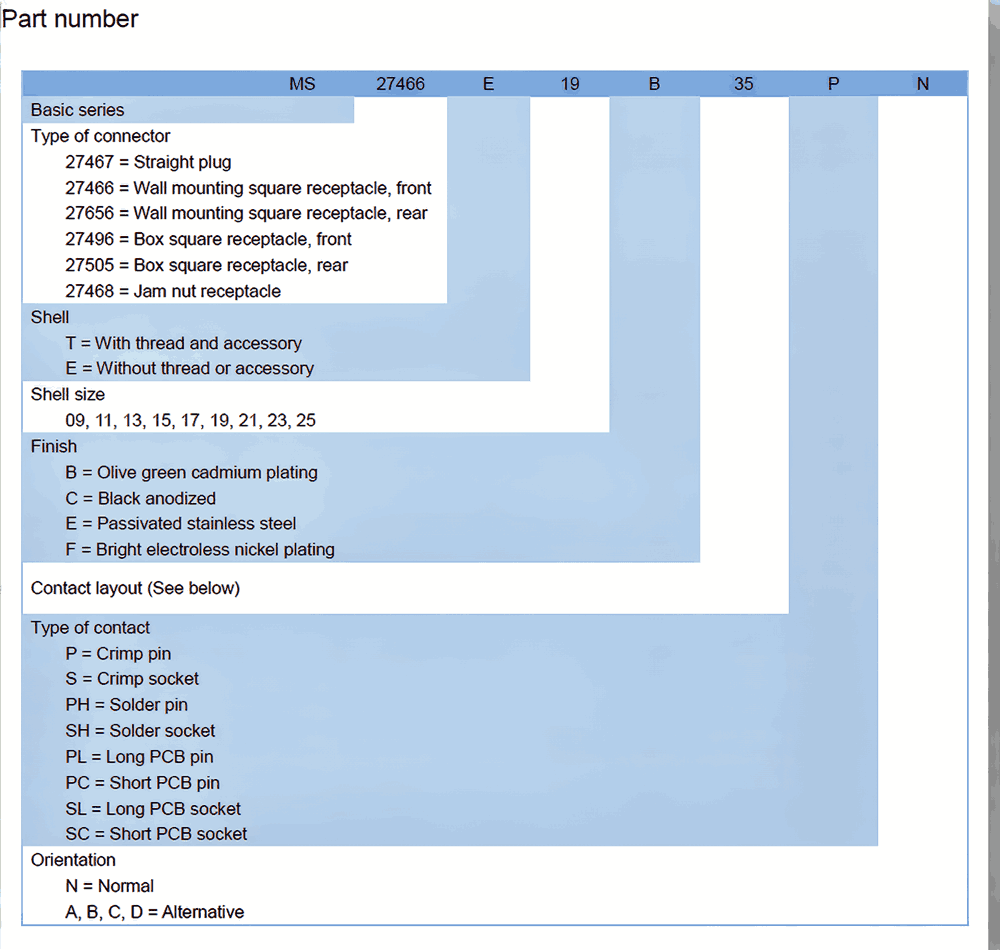
| Position in part number | What it sets |
| MS | Military standard prefix |
| 27466 | Wall-mount square receptacle, mounted from the front |
| T | Shell threaded at the rear for an accessory |
| 23 | Shell size |
| B | Olive-green cadmium plating |
| 35 | Contact layout |
| P | Crimp pin contacts |
| B | Alternative keying orientation |
| Contact options | Crimp pin, crimp socket, solder pin, solder socket, long and short PCB pin and socket |
| Finish options | B olive-green cadmium, C black anodized, E passivated stainless steel, F bright electroless nickel |
| Keying options | N normal, A / B / C / D alternative |
Ordering & Delivery
- Buying direct — orders are quoted by the mil-dtl-38999 connector manufacturer rather than through a reseller, so volume pricing for aerospace and defense procurement is built against your actual schedule instead of a published list.
- Technical contact — as a military circular connector supplier working from our own factory floor, we answer fit, mating and termination questions from build data rather than from a catalogue description.
- Quantity — Flexible MOQs. Give us the annual program volume and the first release separately; that is how a workable schedule gets built.
- Delivery — Stable global delivery. Shipments consolidate out of Shenzhen and are scheduled against your build plan; confirm the current lead time for your configuration with your sales contact.
- What to send with the enquiry — the full part number or the mating half you are replacing, contact type and finish, quantity and any drawing revision. A photo of the existing connector's markings usually settles the remaining questions.
- Beyond the listed range — if the layout, plating or keying you need is not in the list, ask: a custom mil-dtl-38999 connector is usually a suffix decision rather than a new design.
- Terms and documentation — payment method, packing and shipping terms are confirmed at quotation; ask your sales contact about sample availability and about any test or inspection paperwork your program needs attached to the order.
- Reordering — quote the original part number exactly. The plating and contact codes are what keep the second batch interchangeable with the first.
Technical Support & Model Matching
Selecting the right connector is rarely a one-line decision. Send us your drawing, part number or a sample, and our engineering team will confirm the matching shell size, contact arrangement, coupling and mounting style, cross-reference discontinued or alternate part numbers, and advise on sealing and flange options for your environment. We also help troubleshoot fit, mating and signal problems, and give installation and commissioning guidance so your line stays up. As a direct manufacturer, our answers come from the people who build the parts — from first enquiry through after-sales support.
FAQ
How do I read the part number on this connector?
Take it left to right: MS is the military prefix, 27466 means a wall-mount square receptacle mounted from the front, T means the shell is threaded for a rear accessory, 23 is the shell size, B is olive-green cadmium plating, 35 is the contact layout, P is a crimp pin contact and the final B is an alternative keying orientation. Every character is functional — change one and you have a different MIL-DTL-38999 Series I connector, not a cosmetic variant.
Is it waterproof before it is mated?
No — the IP67 rating belongs to the mated pair. The interface seal only closes when the plug is fully coupled, and the rear seal depends on a backshell being fitted and tightened. Unmated on a bench the receptacle is protected against dust and handling, but a waterproof military circular connector is only waterproof as an assembly. If your installation leaves shells open for long periods, protective caps are worth considering for the exposed end.
Can the contact type, finish or keying be changed?
Yes, within the codes the series defines: crimp pin, crimp socket, solder pin, solder socket, and long or short PCB pin and socket contacts; B, C, E and F finishes; and N or A to D keying. If a program needs a custom mil-dtl-38999 connector, send the drawing or the mating part number and we will confirm which of those variables has to change to match it.
What stops the coupling from loosening under vibration?
The threaded coupling ring. It draws the two halves together under tension and holds that tension instead of relying on a spring latch, so vibration has to unwind a thread rather than flick a clip. Full engagement gives a mechanical stop you can feel and see, and the joint stays put through thermal expansion and contraction. That is what makes this a vibration resistant circular connector rather than a general-purpose one.
Will it mate with the plug I already have?
Only if the shell size, contact layout, keying orientation and contact gender all match. Shell 23 and the 35 layout are fixed on this part, and the final B moves the keyway to an alternative position, so a normal-keyed plug of the same shell size will not seat on it. Send the marking stamped on your existing plug and we will confirm the match before anything is built. The receptacle is only as good as the plug it is coupled to — the seal, the shielding and the vibration performance are all properties of the mated assembly.
What temperature range does it handle?
The MIL-DTL-38999 Series I envelope is what makes this a high temperature circular connector: -65 °C to +200 °C. Contact retention, seal materials and plating are chosen to live inside that range, but continuous operation near the top of it is a different duty from short excursions, so tell us which you expect. Confirm the qualified range against the datasheet for your exact contact and finish combination before it goes into a thermal specification.