Product Overview
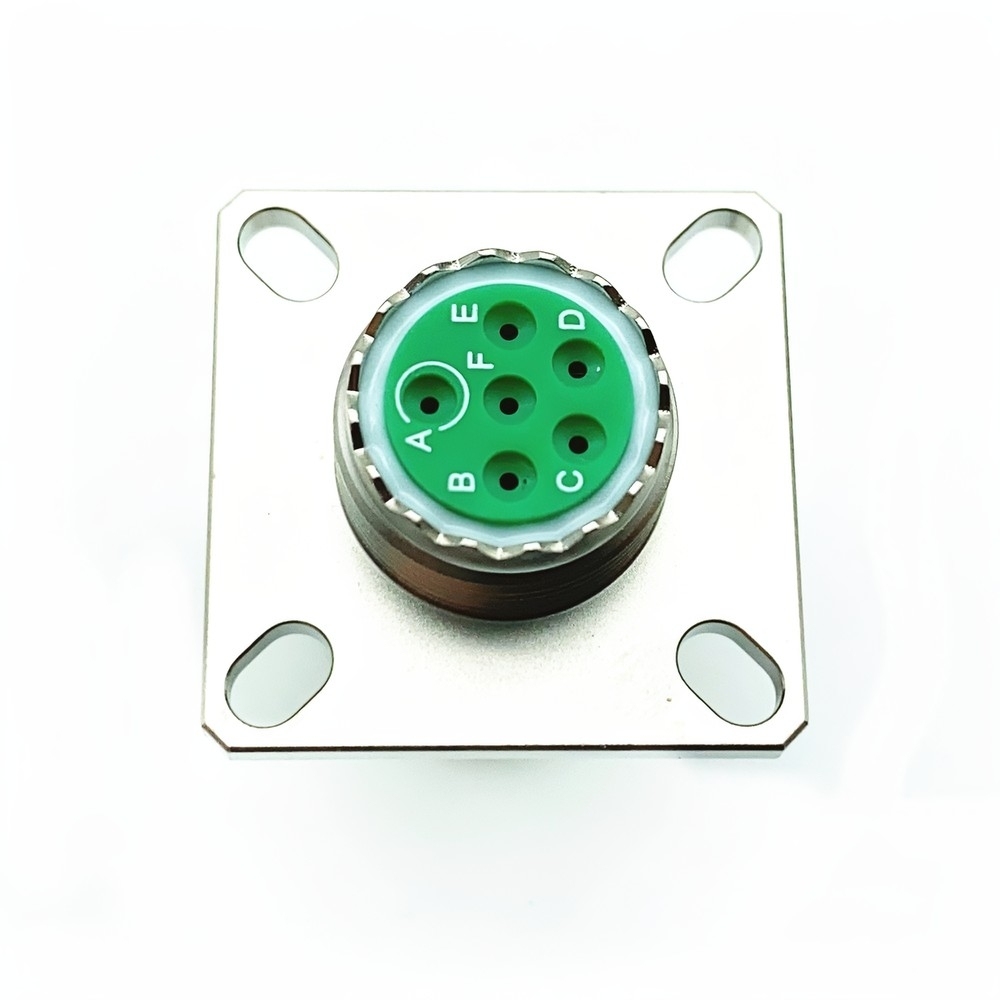
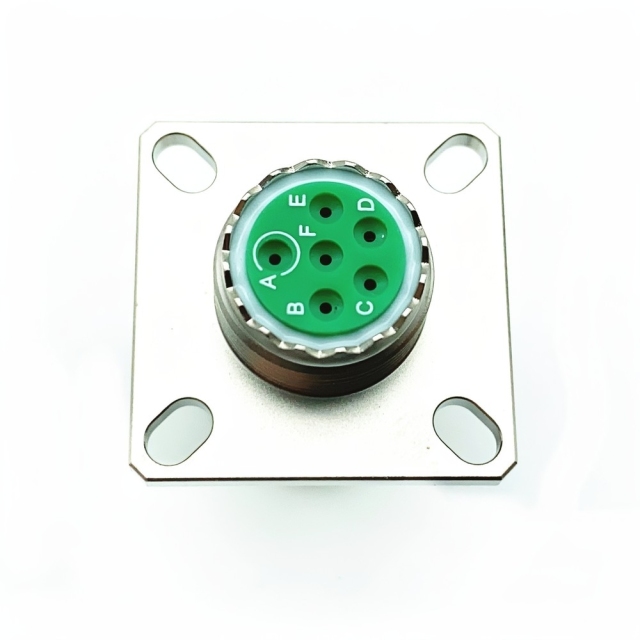
Built to the MIL-DTL-38999 Series III interface, this panel mount military connector is the fixed half of a circular connector pair: a square flange receptacle that bolts flat to a panel, bulkhead or equipment housing, with a matching plug threading onto the front. The shell is machined from lightweight, corrosion-resistant aluminium alloy and finished in olive green cadmium — the W code in the part number — the plating traditionally chosen where salt spray, fuel and hydraulic fluid are part of everyday life. Inside, a hard dielectric insert carries labelled contact positions for crimp pin contacts, so a cable assembly can be terminated on the bench and loaded afterwards. Cable assembly shops, interconnect distributors and repair depots buy it as the panel side of an assembly: the receptacle stays bolted down and the plug travels with the cable. Because the part follows the published MIL-DTL-38999 standards, an assembly already designed around a 38999 series iii connector keeps the interface defined by the standard — shell size, keying and contact layout stay on the drawing — which is what allows a legacy cable assembly to be re-supplied to the same specification.
Environmental & Mechanical Performance
- Temperature: rated for service from -65 °C to +200 °C, so one shell covers cold soak at altitude and heat soak beside an engine or hydraulic line.
- Moisture sealing: IP67/IP68 protection against moisture ingress keeps water out of the contact cavity during wash-down, heavy rain and deck-level condensation.
- Salt fog and chemicals: the olive green cadmium finish is the traditional choice where salt spray, fuel and hydraulic fluid attack bare aluminium, and it takes the scuffing of repeated mating.
- Shock: contact retention and the insert are built to hold under high shock loading, so a hard landing or a strike under a vehicle does not walk a contact out of position.
- Vibration: once the coupling is fully home, thread preload keeps the plug tight against the receptacle and contact resistance stable; a threaded coupling military connector does not depend on a detent spring to stay seated.
- Contact interface: gold-plated copper alloy contacts resist fretting corrosion at the mating face, the usual cause of intermittent signal on a 38999 series iii connector that has been mated hundreds of times.
- Weight: the aluminium alloy shell keeps mass down on airborne brackets and densely packed panels without giving up shell strength.
Mounting & Mating Sequence
- Check the panel and cut-out. The square flange seats flat against the panel face on four fixing holes; a panel mount military connector of this type needs the shell size 13 cut-out and hole pattern from the drawing, and the flange must sit square so the plug starts on the thread cleanly.
- Crimp and load the contacts. Terminate each wire with the crimp tool matched to the contact, confirm the contact is fully seated in the insert, and keep the layout chart to hand so positions are loaded in the right order.
- Align the keying. Orientation B gives an alternative key position to the standard N, so line the keys up before the thread engages — especially on a panel carrying several connectors of the same shell size.
- Start the thread by hand. Series III uses a triple-start thread that pulls up within a short rotation, so a threaded coupling military connector should start without force. If it does not, stop and re-check the keying rather than winding it on.
- Tighten, then verify. Bring the coupling up to the torque your work instruction specifies, then check continuity and pull-test the wire bundle to confirm the contacts are locked in the insert.
- Confirm the mating half. This shell takes a Series III plug of the same shell size and keying, whatever MIL-DTL-38999 connector manufacturer built it; where an old drawing names a bayonet military circular connector, the plug comes from a different coupling family and will not thread onto this receptacle.
Contacts & Electrical Ratings
| Contact style | Crimp pin (code P) |
| Contact material | Gold-plated copper alloy |
| Signal current | Up to 5 A per contact |
| Power current | Up to 23 A per contact |
| Voltage rating | 1,500 V AC RMS |
| Contact arrangements | Signal, power, coaxial and high-speed data layouts can share one shell |
| Termination | Crimp, with insertion and extraction tooling matched to the contact size |
| Mating half | Series III plug with socket contacts, same shell size and keying |
Critical Applications
- Armoured vehicles and military ground systems: bulkhead feedthroughs for power distribution, lighting and sensor harnesses, where the panel takes continuous shock from rough ground and dust never settles.
- Missile guidance and radar: rack and enclosure interfaces that must hold their electrical characteristics through transport and launch vibration.
- Avionics bays and engine control units: an aerospace circular connector on a firewall-side panel, where the shell has to sit through heat soak and pressure cycling without losing its seal.
- Flight data recorders, UAVs and satellite subsystems: compact airframes where the mass of every connector on the loom is counted, so an aluminium shell at shell size 13 earns its place.
- Portable field communications: man-pack and vehicle-mounted radio sets that are mated and unmated in the open, often in the dark and with gloves on.
- Shipboard, offshore and maritime navigation: deck-level and engine-room installations where salt-laden wash water and continuous machinery vibration arrive together, the combination a threaded coupling military connector is normally specified for.
- High-reliability industrial: oil and gas exploration sensors, emergency response equipment and medical life-support devices that borrow the same sealed, keyed interface a MIL-DTL-38999 connector manufacturer builds for defence programmes.
Part Number Breakdown
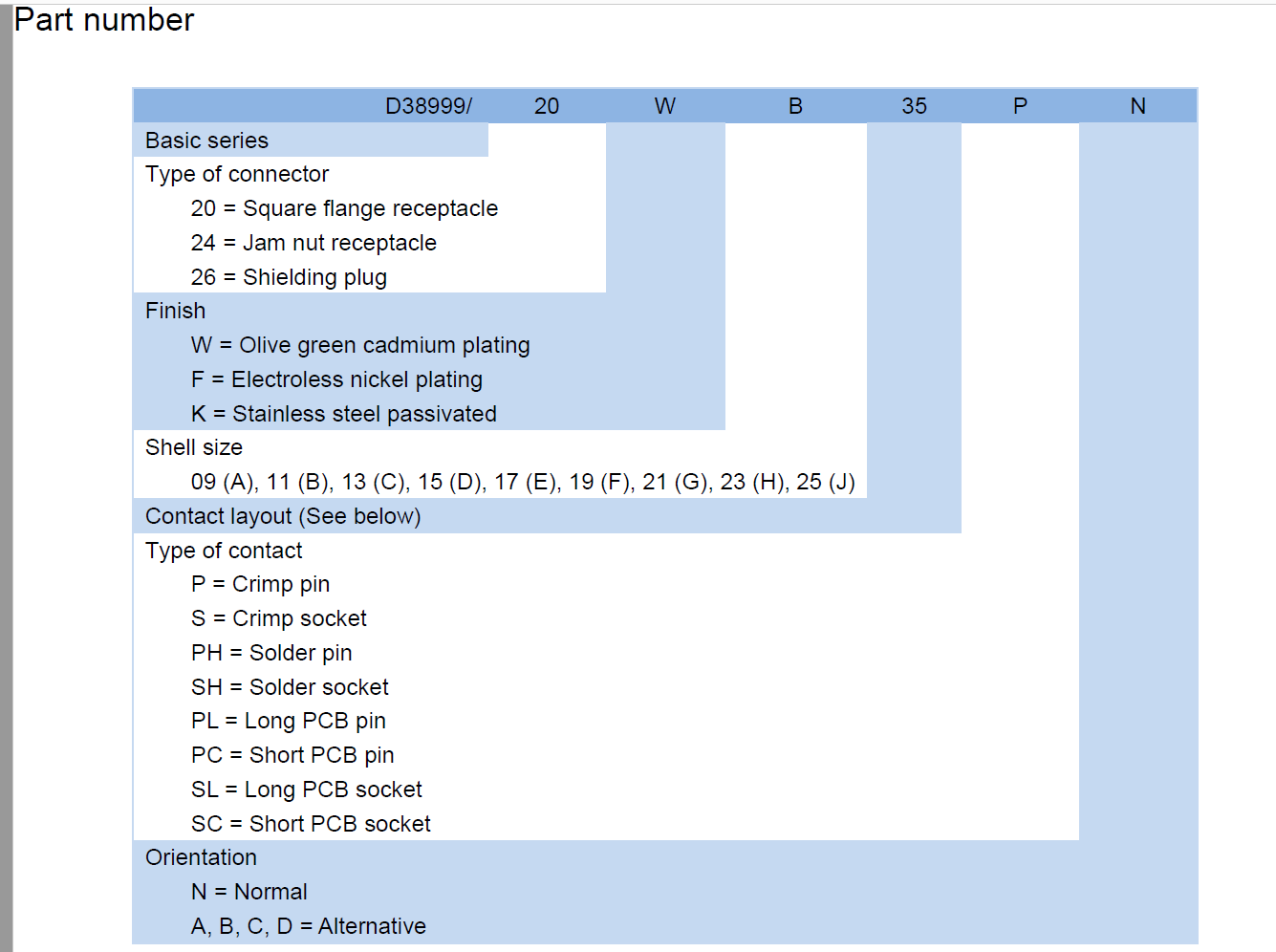
| Part number | D38999 20WC98PB |
| Series | MIL-DTL-38999 Series III |
| Type code 20 | Square flange receptacle |
| Finish code W | Olive green cadmium plating |
| Shell size code C | Shell size 13 |
| Contact layout 98 | Layout 98, contact count and arrangement per the series layout chart |
| Contact type P | Crimp pin |
| Orientation B | Alternative keying position |
Shell Finish Selection
| Finish code | Plating | Where it fits | Confirm before you release |
| W | Olive green cadmium over aluminium alloy | Salt spray, fuel and hydraulic fluid exposure, where the shell still has to give a metallic path to the panel — the finish this shell is supplied in | Cadmium is restricted on some defence and commercial programmes, so check the drawing and any customer restriction before W goes on the order |
| F | Electroless nickel | Cadmium-free programmes that still need a hard, conductive finish on a shell that is mated and unmated often | Nickel does not read like olive green cadmium at goods-in, so state F on the purchase order or inspection may compare it against the wrong sample |
| K | Passivated stainless steel | Deck-level, wash-down and coastal installations where the shell body itself has to carry the corrosion resistance | Confirm shell mass and the galvanic pairing with the panel and the mating plug before the drawing is frozen |
| Part number position | The W in D38999 20WC98PB | Changing the finish changes the code only — shell size 13, layout 98 and B keying stay as they are | Never order the same part but in nickel; a different finish needs its own part number on both the drawing and the order |
| Mixed plating on one panel | Cadmium shell meeting a nickel-plated or stainless mating part | Common where a legacy panel takes new hardware | Have your engineering team confirm galvanic compatibility at the coupling thread, where dissimilar platings corrode first |
| What goods-in checks | Plating coverage at the threads, flange edges, keyways and coupling ring | Consistent colour and full coverage with no bare aluminium showing at any of those points | Ask for the plating callout on the certificate so inspection checks against a document rather than a photograph |
| Acceptance criteria | Cosmetic marks against real plating defects | Handling scuffs on a sacrificial coating are judged separately from exposed base metal on a sealing or mating surface | Agree the line between the two with us before the first batch, so both inspection benches apply the same rule |
| Paperwork | Finish stated on the packing list and traceability documents | Lets quality sign the plating off without stripping a sample | Tell your sales contact which documents receiving inspection needs when the order is placed, including any finish-specific requirement carried by the aerospace circular connector programme |
Building a Complete Order
- Lock the receptacle configuration. Shell size, contact layout, contact style and keying are fixed by the drawing; if the drawing predates the current layout chart, send the original part number and we will cross-reference the fields for you.
- Add contacts to suit the wire. The P code calls for crimp pin contacts, so order enough for the cable assembly plus a few spares, matched to the wire gauge you are actually running rather than the gauge on an old specification.
- Choose the rear accessory. A backshell or strain-relief boot in shell size 13 protects the crimp joints and takes the load off the wires where the cable assembly leaves the shell.
- Use one model list. As a D38999 connector supplier we hold plugs, receptacles, contacts and rear accessories in the same series, so a build can be quoted as one set of line items instead of three separate purchases.
- Plan repeat builds. For military circular connector wholesale stock, keep the same configuration codes on every release so the next delivery matches the last and the cable drawings do not need touching.
- Check legacy callouts first. If the drawing still names a bayonet military circular connector, send it across before ordering — the mating plug and panel details need confirming, and it is cheaper to find out now.
Ordering & Delivery
The series runs across a broad model list and not every item is shown on our website, so ask for the current model list and the availability of the exact configuration you need before the release goes out.
Tell us what your receiving inspection expects. As a D38999 connector supplier we can confirm which documents can travel with the shipment — traceability paperwork, test records and a packing list — so the goods are not held at the door while paperwork is chased.
For military circular connector wholesale quantities, confirm payment method, incoterm, freight and current lead time with your sales contact, and agree the packing with them at the same time: standard export packing protects the shells and contacts, while a different pack-out for your line has to be quoted before the order is placed.
Choosing a receptacle usually comes down to what happens if the part is wrong. Every connector is put through environmental sealing and high-vibration testing before it is packed, so a seal or coupling fault is caught on the bench rather than in a bay where the wiring has already been closed up. Repairability decides a lot of depot work. Crimp pin contacts come out with a standard extraction tool and go back in with the matching crimper, so a damaged circuit does not mean scrapping the loom or unbolting the shell — the receptacle stays on the panel and only the affected contact is re-terminated. For programme work, continuity of supply matters as much as the metal. A release is not held up while one line item is sourced elsewhere, which keeps an aerospace circular connector build on schedule.
Technical Support & Model Matching
Choosing the right shell size, contact arrangement, keying and coupling for a cable assembly is where most ordering problems start, so our engineers work through it with you before anything is shipped. As a mil-dtl-38999 connector manufacturer, we will cross-reference a part number, drawing or photo of the connector you are replacing against our range and confirm the closest equivalent. After delivery we stay available for mating and installation guidance, wiring questions and fault finding, and we are glad to quote military circular connector wholesale orders and custom designs.
FAQ
Will this 38999 series iii connector mate with the plug already on my cable assembly?
Only if that plug is a Series III part with the same shell size, contact layout and keying. This receptacle is shell size 13 with layout 98 and B keying, so check those three fields against the plug before you commit; send the plug part number or a clear photo of its insert and we will confirm the pair.
Is the coupling bayonet or threaded?
Threaded, with a triple-start thread — the Series III arrangement. Compared with a bayonet military circular connector it takes an extra part-turn to seat, but the thread holds its preload under continuous vibration and gives a visible, feelable indication that the coupling is fully home.
How is this panel mount military connector fixed to the panel?
Four fixing holes through the square flange, with the shell body sitting flat on the panel face. The cut-out and hole spacing follow shell size 13, so ask for the drawing before a panel is machined and check the fixing hardware against your panel thickness. Where there is no room for a flange, the same shell size is also built as a jam nut receptacle.
Which finish should I specify for an aerospace circular connector?
This one carries the W finish, olive green cadmium, the usual choice where salt spray, fuel and hydraulic fluid are present and the shell still has to give a metallic path to the panel. Where a programme restricts cadmium, the same numbering scheme offers electroless nickel (F) and passivated stainless steel (K), each with its own corrosion and conductivity trade-off, so confirm which finish your specification permits before the order is written.
Do the contacts come with the receptacle?
The P in the part number specifies crimp pin contacts. Tell us the wire gauge and how many harnesses you are building, and we will quote the receptacle with the contacts you need — either on the same line or packed separately for your assembly bench. We will match the contact to the wire gauge you specify.