Product Overview
The MS27466T15B35PN is the wall-mount receptacle of the MIL-DTL-38999 Series I range — the 15B35 circular connector in its panel-mounting form, with a square flange that bolts flat against a panel, a shell fixed from the front, and a threaded rear for a backshell or strain relief. Thirty-seven crimp and solder pin contacts sit in one insert, so a single panel penetration carries a full cable bundle instead of three or four smaller circular cutouts.
Series I is the bayonet-coupled member of the 38999 family, and this is the half that stays on the panel — the mating plug comes from the same range and is ordered as its own part. The shell is sealed and shielded, so the same receptacle mounts inside a vehicle, on an equipment rack or on an outdoor cabinet without being redesigned for each one.
Before the panel is machined, check three things against the wiring drawing: the shell size, the contact arrangement and the key position. Those three codes decide whether the mating half will engage, and they are far cheaper to confirm on paper than on a finished enclosure — which is why an MS27466 connector supplier asks for the drawing before the shell is cut.
Key Features
- Bayonet coupling that stays locked. A short twist engages the coupling ring, and the ring holds through the vibration a Series I shell is qualified for — no lock wire or secondary fastener is needed to keep the pair together.
- Scoop-proof contact protection. The pin field sits recessed behind the shell lip, so a plug arriving slightly off-axis glances off the shell instead of bending a contact. That is the difference between a quick reconnect and a cable assembly repair.
- Threaded rear for accessories. The T shell type leaves a rear thread for a backshell, adapter or strain relief. Order the E shell type instead when nothing will be fitted behind the panel.
- Shielded at the joint. Bonded shell-to-shell and insert-to-shell contact keeps the shield continuous across the mated pair, which matters on cable assemblies routed near radio, radar or switching hardware.
- Panel-ready as supplied. Flange face, gasket seat and keyway all come machined and plated, so this panel mount aerospace connector bolts to a finished panel without fettling or re-drilling.
- Built to the drawing, order to order. We cut, plate and assemble against the same documentation for a one-off test build and for a production release — a MIL-DTL-38999 connector manufacturer works from the drawing, not from a remembered spec.
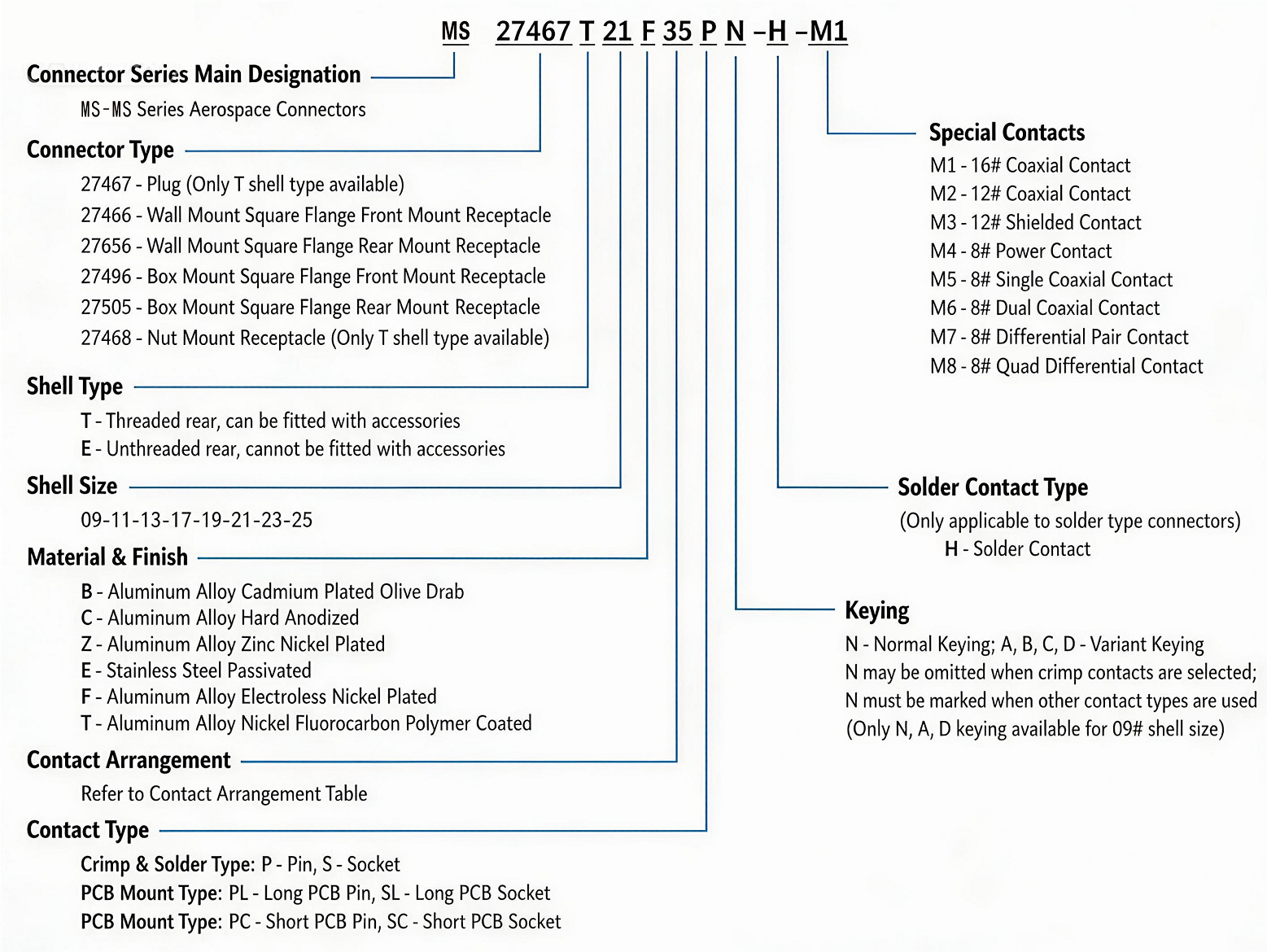
Part Number Breakdown
| Position | Meaning |
| Part number | MS27466T15B35PN connector |
| MS | MS series aerospace circular connector |
| 27466 | Wall-mount, square flange, front-mount receptacle |
| T | Threaded rear shell; backshells and strain relief can be fitted |
| 15 and 35 | Shell size 15 with contact arrangement 35 — 37 contacts; together they form the 15B35 circular connector code |
| B | Aluminium alloy shell, cadmium plated, olive drab |
| P | Pin contacts, crimp or solder termination |
| S | Socket contacts, ordered in place of P — the MIL-DTL-38999 socket connector build |
| N | Normal keying |
| H | Solder contact suffix, used on solder-terminated builds |
| M1–M8 | Special contact codes covering coaxial, shielded, power and differential-pair contacts |
Mounting & Installation
- Match the panel opening to the shell. Cut the opening to the shell 15 wall-mount footprint and drill the four corner holes for the flange screws. On a new enclosure, work from our cutout drawing rather than scaling measurements off the flange.
- Decide on the flange gasket first. If the panel bond has to survive paint, primer or anodising, the conductive square flange gasket goes between flange and panel. Without it, the shell only bonds where bare metal meets bare metal.
- Seat the receptacle from the front. This is a panel mount aerospace connector, so the shell passes through the front of the panel and fixes with flange screws — no access behind the panel is needed to hold the body while it is tightened.
- Tighten in a cross pattern. Bring the flange screws down evenly so the flange seats flat and the gasket compresses uniformly. A flange pulled down hard on one side leaks at the opposite edge.
- Terminate and seat the contacts. Crimp or solder the contacts outside the shell, then push each one into the rear of the insert until it seats and check it is flush with the face. A contact that is not fully home will be pushed back on mating.
- Fit the rear accessory. Thread the backshell or strain relief fully onto the T rear thread so the rear seal loads, then clamp the bundle so the bundle's weight hangs on the backshell instead of on the contacts.
- Mate and lock. Align the keyway, push straight and twist the coupling ring to its stop. The receptacle takes a MIL-DTL-38999 Series I plug from the same family; check the keying matches before the first mating, because a mismatched key will not fully engage and should never be forced.
Applications
A sealed wall-mount flange is chosen wherever a cable bundle has to cross a panel and stay sealed, and the same shell turns up in quite different places on one programme. On aircraft it sits on equipment-bay panels, antenna bulkheads and avionics racks, where a 37-contact bundle has to pass a pressure or fire boundary in a single penetration rather than several. Ground support and test equipment use it because the bayonet ring comes apart quickly between test runs and locks positively again for transport. Defence electronics and vehicle wiring rely on the scoop-proof front end when the connector is mated by feel, in the dark or through a glove. Marine and coastal installations pick the plated aluminium shell for salt-laden air, and industrial control cabinets use it where washdown, coolant mist or continuous vibration would work an unsealed connector loose. It is also the part maintenance teams reach for first.
Materials, Plating & Sealing
- Shell alloy and finish. The standard build for this part is an aluminium alloy shell with cadmium plating in olive drab, the B code in the number. The range also covers hard anodised (C), zinc-nickel (Z), electroless nickel (F), nickel-fluorocarbon polymer (T) and passivated stainless steel (E).
- Which finish suits which job. Cadmium over aluminium is the traditional choice where a conductive, corrosion-resistant surface matters. Hard anodising is better where abrasion dominates and shell conductivity is not required. Zinc-nickel and electroless nickel are common where a cadmium-free finish is preferred, and passivated stainless takes the hardest wear and cleaning regimes.
- Contact plating. Gold over nickel keeps contact resistance low and stable through repeated mating, and holds up to the sulphur and salt load of a coastal installation.
- Insert and contact retention. The moulded dielectric insert holds every contact at a fixed spacing, so the field does not drift under shock and a mating plug meets each contact on centre. The same insert is used whether the shell is built with pin contacts or supplied as a MIL-DTL-38999 socket connector with S contacts.
- Keyway and scoop-proof lip. The key and the shell lip are machined so a MIL-DTL-38999 Series I plug lines up on the key before the contacts touch — which is why a mis-keyed mating cannot push a pin back through the insert.
- Sealing at three interfaces. Flange, insert-to-shell and rear entry are sealed separately, so the contact chamber stays dry even if one gasket is disturbed during a panel build.
- Materials kept in production. As an aerospace circular connector OEM these alloys and platings are routine builds for us, so specifying a harder-wearing finish does not turn the order into a one-off shell.
- Checked before dispatch. Every connector is examined for environmental sealing and high-vibration performance before it leaves the line, so a sealing or seating fault is caught here rather than on your panel.
Ordering & Delivery
We hold spot stock on the common Series I configurations and take custom orders for everything else, so a scheduled production release and a line-down replacement can both come off the same line. Flexible MOQs let a first-article build and a full release be quoted together, and stable global delivery keeps repeat shipments on the schedule a programme is planned around.
Send the complete part number, the quantity and any suffix you need — C1 for the fluorosilicone seal, C2 for the conductive flange gasket, or a special contact code — and we confirm the configuration before the order is released. Trade terms, packing method and shipping route are settled on the quotation at that point. If a programme needs marked bags, kitted sets or a particular carton layout, raise it at enquiry stage so it is priced in rather than added afterwards.
We ship from our own production, so a question about the build reaches the line rather than a distributor's desk. Confirm current availability and terms with your sales contact before releasing a scheduled order.
- The full Series I range. As a MIL-DTL-38999 connector manufacturer we build the whole Series I family, and only part of it is listed here. If the shell size, contact arrangement or finish you need is not shown, send the complete part number — orders outside the catalogue are routine.
- GJB599B and MIL-DTL-38999M describe the same part. The two designations are identical in every section except the main code: GJB599B uses "JY" where MIL-DTL-38999M uses "MS". They are fully interchangeable and will mate with each other, so a JY-numbered drawing and an MS-numbered part can sit on the same cable assembly.
- High oil resistance — add C1. Where the application calls for high oil resistance, the sealing material is changed to fluorosilicone rubber and C1 is added to the end of the original part number.
- Conductive square flange gasket — add C2. Where the assembly needs a conductive square flange gasket, add C2 (or (C2)) to the end of the part number.
- More than one shell type. The same system runs through plugs, box-mount receptacles, rear-mount receptacles and nut-mount receptacles, so a panel that needs rear access or a floating mount can be specified from the same family instead of a different connector range.
- Contact variants. Pin or socket, crimp and solder or PCB, plus the M-series special contacts for coaxial, shielded, power and differential-pair runs — the table above shows where each code sits.
- Order against the whole number. As an MS27466 connector supplier we build from the complete part number — shell type, size, finish, arrangement and contact code — rather than from a generic equivalent.
- Receptacle, plug and accessories from one plant. As an aerospace circular connector OEM we cover both halves of the mated pair and the rear accessories, so a change to finish or keying is handled by the same team that builds the shell.
- Arrangement matters as much as shell size. Shell size 15 covers several contact arrangements, and arrangement 35 is what gives this 15B35 circular connector its 37 contacts. Check the arrangement on your wiring drawing before the order is placed.
Technical Support & Model Matching
Selecting the right connector is rarely a one-line decision. Send us your drawing, part number or a sample, and our engineering team will confirm the matching shell size, contact arrangement, coupling and mounting style, cross-reference discontinued or alternate part numbers, and advise on sealing and flange options for your environment. We also help troubleshoot fit, mating and signal problems, and give installation and commissioning guidance so your line stays up. As a MIL-DTL-38999 connector manufacturer, our answers come from the people who build the parts — from first enquiry through after-sales support.
FAQ
Can I use this receptacle with plugs and backshells from another supplier?
Yes, as long as they are built to the MIL-DTL-38999 Series I interface. The coupling, keyway and shell threads follow the standard rather than a proprietary pattern, so a plug or backshell from another source will fit provided the shell size, arrangement and keying match. Because we build to that same standard, a single receptacle can be dropped into a wiring assembly designed around a different maker's parts.
Can the same part number be built with different contacts or finishes?
Yes. The contact code and the finish letter sit in separate positions of the number, so the shell can be supplied with pin or socket contacts, crimp or solder termination, and in the other finishes covered in the breakdown above. As an MS27466 connector supplier we build to the whole number rather than to a stock description, so send the exact code you need and we will confirm the build against it before the order is released.
Does this connector suit an airframe or defence wiring assembly?
That is the work it was designed for. A wall-mount flange, a scoop-proof front end and a sealed shell are the combination airframe and defence harnesses ask for, and as an aerospace circular connector OEM we build the same shell into marine and heavy industrial assemblies where the environment is just as unforgiving. The finish letter is what you match to the specific environment; the mechanical build stays the same.
Is the MS27466T15B35PN connector interchangeable with a JY-numbered part?
Yes. GJB599B and MIL-DTL-38999M describe the same connector in every section apart from the main designation code, where "JY" replaces "MS". The two are fully interchangeable and will mate with each other, so a JY-numbered part with the same shell size, arrangement and keying fits the same panel opening and takes the same plug.
What plug mates with this receptacle?
Any plug from the same shell system — a MIL-DTL-38999 Series I plug with a matching shell size, contact arrangement and key position will engage and lock on the bayonet ring. A plug built on a different arrangement will not engage, and it should never be forced. If you are replacing one half of a working pair, send us the number from the other half and we will confirm the match before you order.
What does the 15B35 code tell me?
It is the shell size and the contact arrangement read together: shell 15, arrangement 35. On this part that combination gives the 37-contact field, which is why it is worth checking the arrangement code rather than the shell size alone — shell 15 is used with several different arrangements, and they do not all carry the same number of contacts. Confirm the arrangement on your cable assembly drawing before ordering.
Pin or socket contacts — which do I order?
Pin contacts (P) are the standard build for this receptacle, and the mating plug then carries sockets. If your cable assembly is built the other way round, the same shell is available as a MIL-DTL-38999 socket connector with S contacts in place of P. Whichever you choose, keep the arrangement code the same on both halves so the pin field lines up when the pair is mated.