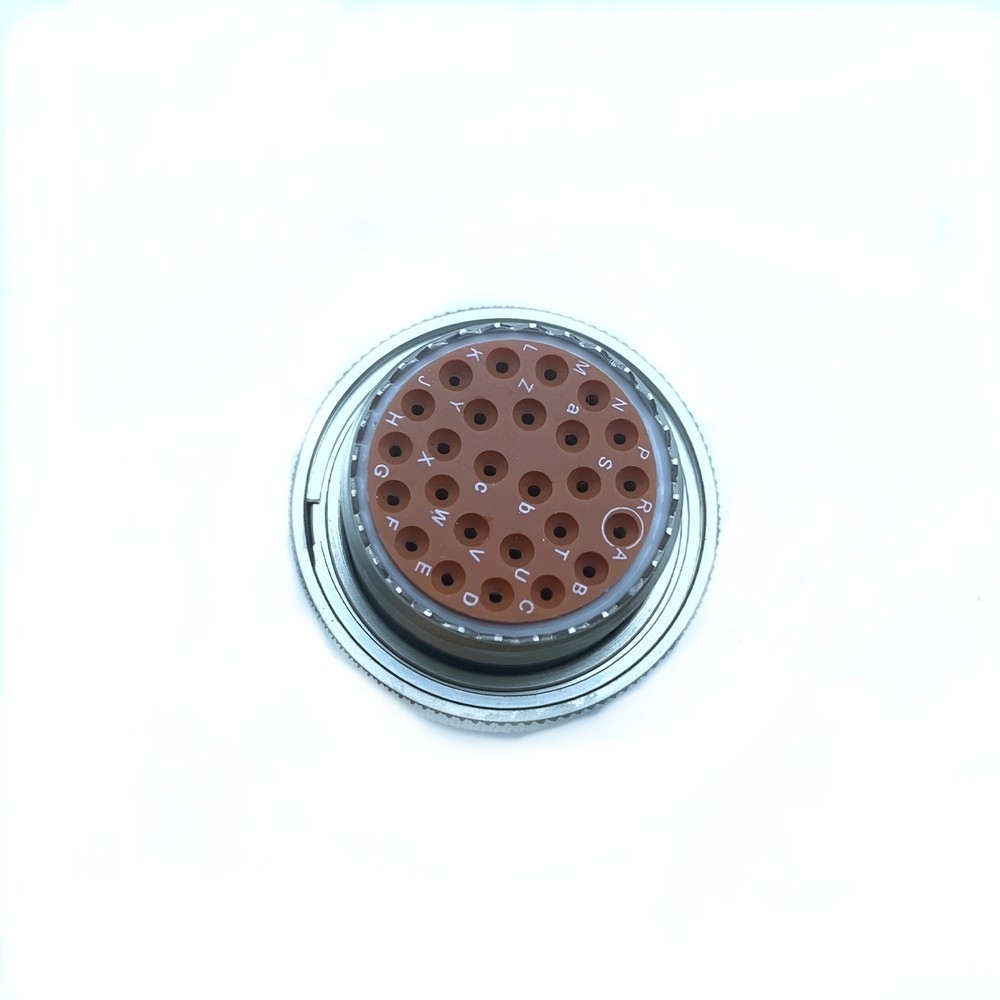
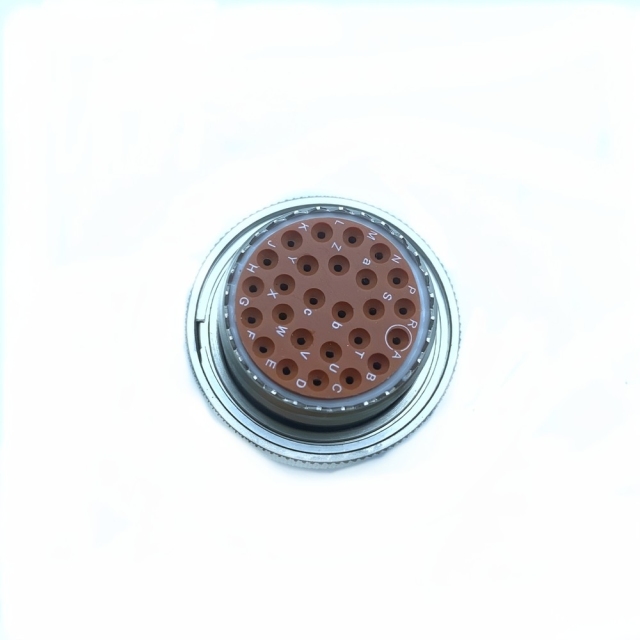
Product Overview
As a threaded coupling military connector, this plug sleeves onto its receptacle and locks with a part-turn of the knurled ring — no tools, no locking wire, no fumbling behind a panel. It is the cable half of the pair: the plug rides on the cable bundle, mates to a panel mount circular connector fixed to the equipment, and comes apart at the coupling when the assembly has to be opened for test or service. The shell is size 16, which sits in the middle of the Series II range — enough room for a multi-contact insert without the bulk of a 20 or 22 shell on a crowded panel. In daily use this is a bench-assembled part. Wires are crimped to contacts, contacts are inserted until they seat, and the finished plug is fitted to the loom before the loom goes anywhere near the equipment. Repair follows the same path in reverse, which is why loom shops keep the plug on the bench and only fit it to the airframe or the vehicle once the loom has passed its checks.
Key Features and Technical Specifications
MIL-DTL-38999 Series II is a specification, not a marketing label. It fixes the interface geometry, contact retention, keying, and the mechanical, environmental and electrical test regime a connector has to survive before it can carry the designation. Because the interface is published rather than proprietary, mating halves built on different production lines still engage, provided the series, shell, layout and keying agree. The range covers the shell sizes and mounting styles most cable drawings ask for: plugs, wall and box receptacles, jam-nut receptacles and shielded plugs, across a spread of finishes and contact types. Coupling is where it splits. This part uses the threaded version, which holds under sustained vibration; where a cable assembly needs quarter-turn mating, the same family is offered as a bayonet military circular connector, so the panel cutout and the contact system stay familiar while the coupling action changes. That published interface is also why sourcing an MS27473T16F26SB connector wholesale comes down to the drawing rather than the badge. A 38999 Series II connector manufacturer is judged on whether the part meets the interface shell for shell and contact for contact, which is what makes the plug a drop-in for an existing cable assembly instead of a redesign.
| Standard | MIL-DTL-38999 Series II |
| Connector type | Plug, shell 16 |
| Contact layout | 26 |
| Contact type | Crimp socket (S) |
| Shell finish | Electroless nickel (F) |
| Coupling | Threaded, quick-disconnect |
| Mounting | Cable mount, mates with panel receptacles |
| Sealing | IP67 when mated |
| Operating temperature | −65 °C to +200 °C |
| Vibration | 10–2000 Hz |
| Shock | 100 G |
| Shielding | EMI shielding, stable impedance, low insertion loss |
Advanced Contact System
Contacts are gold-plated. The plating keeps contact resistance low and stable across the insert, and resists corrosion at the mating interface, where two metal surfaces meet, separate and meet again. In a shell that may be mated and unmated many times over its service life, that is what stops the electrical path from drifting out of specification.
This plug carries the socket side of the pair, and the mating receptacle supplies the pins. Sockets protect the thinner, more easily deformed pin during handling and inspection, which is one reason the arrangement is common on the wiring side of a connection.
Termination is by crimp. A controlled crimp is made with a set die depth rather than by hand, so every termination in a loom is repeatable, no heat is applied near the insert, and a joint can be inspected and remade without disturbing the rest of the connector.
Contact retention deserves attention at assembly. Each contact should push home and seat positively in the insert; one that stops short will back out under vibration long before it fails electrically, and the resulting fault usually shows up as an intermittent circuit rather than an obvious break.
Every MIL-DTL-38999 Series II connector in the range uses the same gold-plated contact system, so insertion and extraction tools and contact spares carry across shell sizes instead of being bought part by part.
Hybrid Sealing Solutions
- Three seals, not one — the interface seal at the mating face, the individual rear wire seals and the seals in the connector body work as a system. The assembly is only as dry as its weakest seal.
- Mated condition — dust-tight and protected against short immersion once the plug is fully engaged with its backshell fitted. That condition is what earns the part its IP67 military circular connector rating; an unmated plug on a bench is not a sealed assembly.
- Salt fog — the shell finish and the seal materials are chosen to resist salt fog corrosion, the failure mode that catches unprotected aluminium hardware in coastal and shipboard service.
- Flame-retardant materials — the insert and sealing materials are specified to MIL-STD-810 flame-retardancy requirements, so the connector does not add fuel to an electrical fault.
- Rear seals match the cable — a wire seal that sits loose on a thin cable leaks. Check the grommet bore against your actual wire outside diameter before the loom is built.
- Unused cavities — empty contact holes need sealing plugs fitted, or the rear face becomes the path water takes into the insert.
Part Number & Configuration
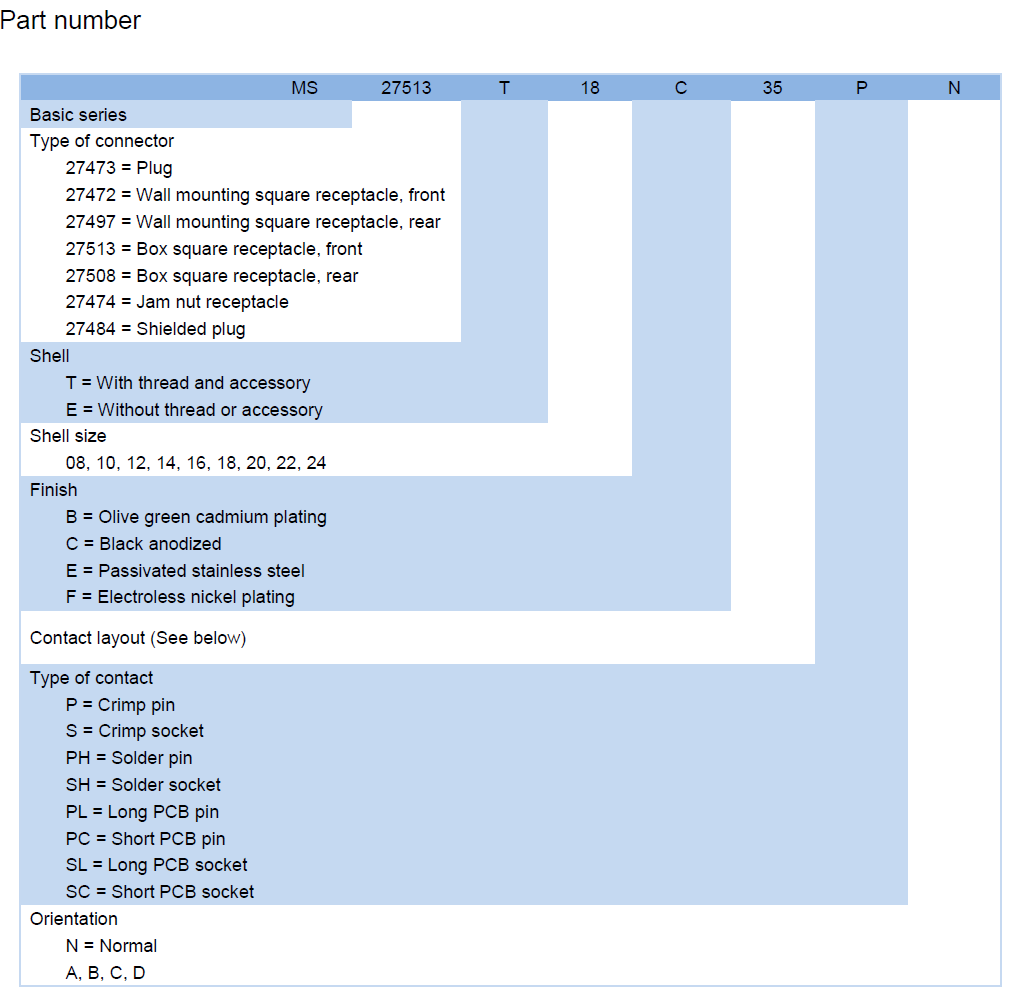
- Connector type block — 27473 is the plug; 27472 and 27497 are wall-mounting square receptacles for front and rear fixing; 27513 and 27508 are box square receptacles, front and rear; 27474 is the jam-nut receptacle and 27484 the shielded plug.
- T or E — T means the shell carries the rear thread and accessory fittings, E means it does not. This plug is the T version, so a backshell, boot or strain relief has something solid to clamp to.
- Shell size — two digits running from 08 to 24. Size 16 sits mid-range: more room than the small shells, less bulk than 20 and 22 where panel space is tight.
- Finish — B olive green cadmium, C black anodized, E passivated stainless steel, F electroless nickel. This plug is F.
- Contact layout — the two digits after the finish define the arrangement of contacts in the insert. One shell size can carry more than one layout, so the layout code matters as much as the shell size.
- Contact type — P crimp pin, S crimp socket, PH solder pin, SH solder socket. This plug is S, the socket half of the pair.
- Trailing letter — sets the keying or polarization of the insert. It has to be quoted in full so the mating half is built to the same keyway, which matters just as much on an MS27473T16F26SB connector wholesale order as on a single replacement plug.
- Coupling variants — where the application calls for quarter-turn action rather than threads, the same inserts are supplied as a bayonet military circular connector, with the same panel and contact conventions.
Coupling, Keying & Field Service
- Line up the keyway first — a threaded coupling military connector only engages cleanly when the key on the plug meets the keyway on the receptacle. Forcing it past that point is how contacts get bent.
- Seat the plug, then turn the ring — push the plug fully home and rotate the knurled coupling ring by hand. If the ring binds, stop and re-check the keying rather than adding leverage.
- Confirm full engagement — the ring should bottom out. A ring left part-way round is the commonest reason an IP67 military circular connector pair leaks.
- Split at the coupling for service — field repairs open at the ring, so the backshell, the loom and every termination stay untouched while a module is swapped or tested.
- Read circuits from the insert — the colour-coded insert lets a technician identify a circuit position during assembly or fault-finding instead of counting cavities against a drawing.
- Check the seals before re-mating — a few seconds on the interface seal and the rear grommets catches the grit and nicks that turn into leaks later.
Aerospace Applications
- Avionics bays and flight control runs — dense wiring behind panels, where a compact shell and a coupling that cannot work loose matter more than a high contact count.
- Engine and nacelle monitoring — sensor wiring routed through heat-soaked zones, where the insert has to hold its shape and keep every contact aligned.
- Airframe and cabin systems — looms built and tested on the bench, then threaded through structure, with the plug protecting the contact interface until final mating.
- Ground support and test rigs — equipment mated and unmated far more often than the aircraft itself, where a ring that turns by hand saves time on every shift.
- Programme continuity — aerospace programmes tend to qualify one military circular connector supplier and stay with that source, because changing supplier mid-build means re-qualifying the part and the wiring that carries it. The connector is built for ergonomic field maintenance, with color-coded inserts that simplify assembly and troubleshooting during servicing.
Military & Defense Applications
Defence electronics put connectors where the environment is worst. Radar and communications racks run continuously under vibration, tactical vehicles cross ground that shakes every joint in the loom, and field shelters go from dust to driving rain in an afternoon. Cable assembly drawings for these assemblies are usually built around a MIL-DTL-38999 Series II connector because the interface is already on the platform's qualified parts list and the cable assembly shop already owns the tooling for it.
Inside the vehicle or shelter the mating half is normally fixed to a bulkhead or an equipment face, which makes the plug one half of a panel mount circular connector pair. The receptacle takes the fixing, while the plug stays on the cable. That split is deliberate: the fixed half carries the panel cutout and the sealing face, and the travelling half takes the wear of repeated mating.
For units coming back from the field, the same split makes repair practical. A damaged plug is replaced on the bench while the receptacle stays in the vehicle, so a repair does not need access behind the panel or a new cutout.
Marine & Naval Applications
- Salt-laden atmosphere — marine air attacks unprotected hardware quickly; the shell finish and the seals are what keep the interface clean between maintenance windows.
- Submarine and surface vessel electronics — pressure hull and superstructure systems where the connector is expected to outlast the equipment it serves.
- Machinery-induced vibration — engine rooms and pump spaces load every coupling, and a threaded ring holds where a push-fit body would fret loose.
- Long cable runs between compartments — looms that cross several zones and take a plug at each end, so one spare part covers several runs.
Ordering & Delivery
- Send the pair, not the part — the receptacle code, the contact layout and the cable outside diameter let us confirm the mating pair before anything is built.
- Quote the full code — finish and keying letters are the two characters buyers most often drop, and the two that decide whether the plug fits the panel half.
- Volume and programme quantities — for MS27473T16F26SB connector wholesale volumes, pricing follows your annual usage or build schedule rather than a single line item.
- Flexible MOQs — a repair depot can order a handful while a programme orders against a build schedule.
- Stable global delivery — replenishment runs on a predictable schedule; confirm the current timing for your region and quantity with your sales contact.
- Direct supply — we quote as a military circular connector supplier from our own production, so a technical question reaches the people who build the part.
- Sample availability — ask your sales contact about sample availability if you need a first article for fit and finish checks.
- Packing — tell us at quotation whether parts should ship individually bagged, kitted with contacts and backshells, or in bulk for the cable assembly bench.
- Payment and shipping terms — confirmed at quotation for the destination and order size.
- The specification gets a connector onto the drawing. What keeps it there is whether the part, the price and the paperwork hold up, which is why a military circular connector supplier is judged on the second order as much as the first. Certified Reliability — built and tested to MIL-DTL-38999 Series II, with the mechanical, environmental and electrical clauses covered before a lot leaves the line. In life-critical assemblies, that is the difference between a component and a liability. Reduced Downtime — one shell 16 plug design covers several builds that share the layout and keying, so a depot can hold a single spare line instead of a shelf of near-identical parts, and a suspected fault can be isolated by substitution rather than diagnosed in place. Future-Proof Design — backward compatible with legacy Series II infrastructure. A cable assembly designed years ago still takes this plug, and the same insert and contact system carries across the range, so moving to another shell size does not mean learning a new contact system. Supply Chain Assurance — traceable manufacturing with full documentation support, including certificates of conformance and test reports when the programme asks for them. Buying from a 38999 Series II connector manufacturer that documents each lot is what makes an audit answerable.
Technical Support & Model Matching
Selecting the right connector is rarely a one-line decision. Send us your drawing, part number or a sample, and our engineering team will confirm the matching shell size, contact arrangement, coupling and mounting style, cross-reference discontinued or alternate part numbers, and advise on sealing and flange options for your environment. We also help troubleshoot fit, mating and signal problems, and give installation and commissioning guidance so your line stays up. As a military circular connector supplier, our answers come straight from the people who build the parts — from first enquiry through after-sales support.
FAQ
Will this plug mate with the Series II receptacles already on our panel?
Yes, provided the series, shell size, contact layout and keying all agree. This is a shell 16 plug with the 26 layout, so it pairs with a shell 16 receptacle built to the same layout and keyway. Because the interface is published rather than proprietary, any 38999 Series II connector manufacturer building to the same series, shell and layout produces a mating half. Send us the receptacle code and we will confirm the pair before you commit to a batch.
Is a bayonet version available instead of the threaded coupling?
This listing is the threaded version, where the knurled ring is turned down to lock the plug. The range also includes quarter-turn versions: if your wiring drawing calls for a bayonet military circular connector, give us the code and we will quote the matching item rather than substituting one for the other, because the panel cutout and the mating receptacle are specified around the coupling style.
What does the final letter in the part code change?
The last character sets the keying or polarization of the insert, and it has to match the receptacle. Two plugs that look identical but carry different final letters will not mate with the same panel half. That is why the full string matters at ordering time: a MIL-DTL-38999 Series II connector is defined by its interface, and keying is part of the interface, not a cosmetic suffix.
Can the plug itself be fixed to a panel?
The plug is the cable half, so panel fixing belongs to the receptacle. Where a cable assembly meets a bulkhead, the panel mount circular connector is the wall, box or jam-nut receptacle in the same series, and the plug travels to it. Choose the receptacle by fixing style, keep the shell size and layout matched, and the pair will seat without modifying the cutout.
What tooling does the plug need during assembly?
Crimp contacts need the matching crimp tool and positioner for the contact size used in this layout; insertion and extraction are done with simple hand tools. The plug ships without contacts fitted, so terminations are made on the bench where they can be inspected, and a contact can be extracted and replaced later without disturbing the rest of the insert.
Does the sealing still hold after repeated mating?
The interface seal is a service item rather than a one-time fitment. Repeated mating wears it slowly, and grit or a nicked edge shortens its life faster than cycles do, so it is worth checking on every re-mate. With the plug fully engaged and the backshell fitted, the pair meets the IP67 military circular connector rating; that is the condition the rating describes, which is why a part-mated plug should never be left as a temporary connection.