Product Overview
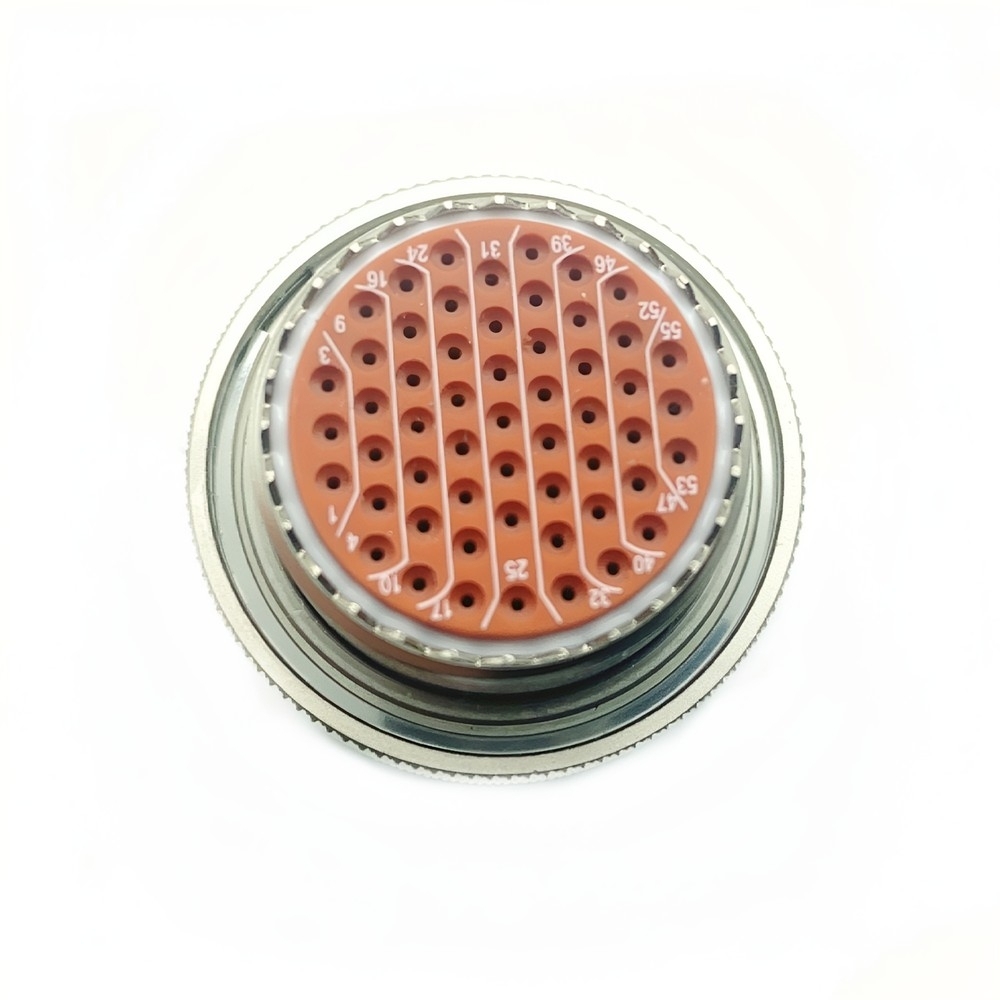
This is a MIL-DTL-38999 Series II connector built as a shielded plug: a metal shell, a keyed insert and crimp contacts. The shielded plug is the cable-end half of a cable assembly. It carries the accessory thread and the shell shielding, mates with a receptacle fixed to a panel, box or bulkhead, and travels with the cable while the receptacle stays bolted to the equipment. Specify it where a cable assembly has to plug into a sealed, keyed interface and come back out for service without disturbing the panel side. As a MIL-DTL-38999 Series II supplier we build the whole mating chain rather than a single part: plugs, wall-mounting and box receptacles, jam-nut receptacles, crimp and solder contacts, and the rear accessories that finish a cable assembly. That matters when a drawing names a specific shell and layout, because the plug, the receptacle it mates with and the contacts all come from one range, so keying, thread and contact alignment stay consistent from build to build. The family also keeps programmes simple. This configuration is one entry in that family; the other shell sizes, finishes and contact types are built to the same drawings.
Coupling, Vibration and Shock Integrity
- The T in the code gives this shell a thread and an accessory: the coupling threads engage progressively and hold the mated pair together, which is what stops a cable-end plug backing off on an engine or vehicle wiring.
- Where a bayonet military circular connector is specified instead, the coupling is push-and-turn. It is quicker to mate and un-mate where access is tight, while the threaded shell is the usual pick where the joint stays closed for the life of the platform.
- Vibration is a joint problem rather than a plug problem. The plug, the receptacle it locks into and the cable all move together, so the backshell and any cable clamp should carry the load instead of the contacts.
- Contacts are held in place by the insert, and their retention is what stops signal chatter under shock. Seating every contact fully during assembly is the single most useful thing an assembler can do for reliability.
- On an aerospace circular connector, the shock load often arrives as a single event: a hard landing, a firing pulse or a bench drop during handling. The shell, the coupling and the mounting hardware are what absorb it.
- After a service period in a high-vibration location, check coupling tightness, backshell condition and seal seating before re-mating. Those three checks catch most of the wear that shows up in the field, and the seals, backshells and contacts they call for come from the same MIL-DTL-38999 Series II supplier that built the plug.
Triple-Seal Environmental Protection
Sealing is built in three layers. The interface seal closes the gap between the mated plug and receptacle, the rear wire seals close around each individual wire as it leaves the insert, and the body seals close the shell itself. A failure in any one layer shows up as moisture at the contacts, so all three are part of one system rather than optional extras.
The materials are chosen for the conditions a MIL-DTL-38999 Series II connector actually meets: salt fog on deck or at a coastal site, thermal cycling between a cold soak and engine-bay heat, and fuels and hydraulic fluids around an airframe. Flame-retardant materials to MIL-STD-810 are used in the assembly, which matters where a cable bundle runs behind a panel in a crewed compartment.
Two practical notes. The water rating applies to a mated pair, so an open plug on a bench is not protected: cap or bag the connector while the cable bundle is disconnected. And the rear wire seal is only as good as the wire it grips, so stay within the wire range the contact and grommet are built for and re-terminate rather than forcing an oversize wire through.
Contact System and Termination Options
The contacts are gold plated. That plating is what keeps resistance low at the interface and stops corrosion building on a contact that sits in damp, salt-laden air for months between services. The insert is polarised as well: keying lets the plug enter the receptacle one way only, so pins cannot be bent by a misaligned push during a blind installation under a panel. Keying and the contact layout are matched to the original drawing, so a replacement plug drops onto the receptacle already on the equipment without re-pinning the existing wiring.
Four termination styles run through this range: crimp, solder, PCB straight and 90° right angle. Crimp is the usual choice for loom work, because the contact is crimped with the matching tool and then pushed in until it locks, which means a damaged contact can be replaced on the bench without disturbing the rest of the loom. Solder contacts suit small builds and repairs where a crimp tool is not on hand. PCB straight contacts mount the connector to a board, and the 90° right-angle version turns the body parallel to the board where there is little depth behind the panel.
Seat every contact fully. A contact that is only part-way home is the most common cause of an intermittent circuit, and it often passes a continuity check on the bench before failing in service. Keep a small stock of spare contacts of the same type with the wiring documentation so a repair does not turn into a full connector replacement. A military circular connector wholesale order is the moment to set that stock up: the contact type is already fixed in the plug code, so the spares can be ordered with the plugs.
Installation and Field Servicing
- Match the numbers first. Check the plug's full part number against the drawing, then confirm the mating receptacle code: whether the equipment uses a wall-mounting square receptacle, a box receptacle or a jam-nut panel mount military connector. Where the drawing names only one half, your MIL-DTL-38999 Series II supplier can confirm the mating code, because plug and receptacle are numbered in the same system.
- Check keying and layout before any contact goes in. The insert key and the contact arrangement must match the receptacle, and the pin and socket pairing must be complementary.
- Seat the plug fully, then engage the coupling. On this threaded shell, thread by hand until the joint is clean and only then bring it up to your cable assembly procedure; where a bayonet military circular connector is used, push and turn until it latches.
- Support the cable. Fit the backshell and any clamp so the loom weight hangs on the shell rather than on the contacts, especially on a cable-end plug that moves with a door, turret or vehicle wiring.
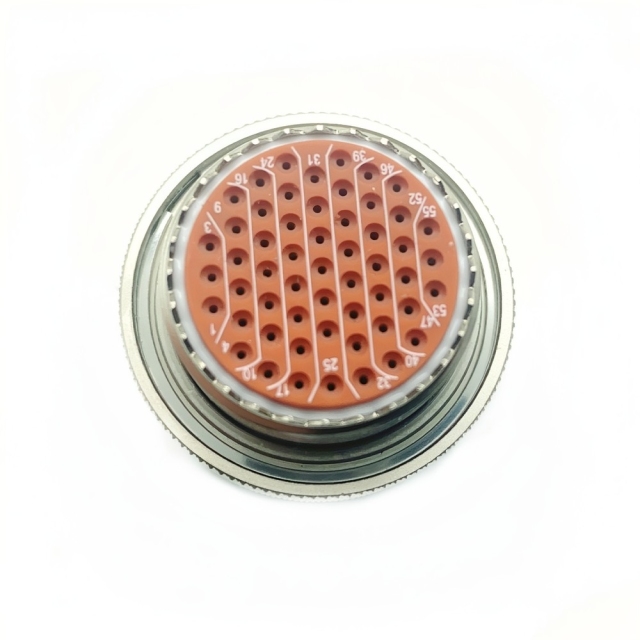
- Service with the coupling in mind. The plug separates without disturbing the panel-side receptacle, and the colour-coded insert face lets a technician identify the layout at a glance during troubleshooting.
- Log the mate. Record the date, the cable assembly and the reason for the break in the maintenance record, because a connector that is repeatedly un-mated and re-mated is the one that eventually needs a seal replaced.
Target Applications
- Aerospace: avionics bays, flight-control runs and engine-monitoring wiring bundles. An aerospace circular connector in these positions is judged on signal stability first and on space and weight second, which is why shell, contacts and seal stack are specified together.
- Military: radar and communications racks, tactical vehicles and field-deployed shelters, where the wiring bundle is mated and un-mated during set-up and the joint has to survive transport vibration.
- Marine: submarine and naval vessel electronics, where salt fog and constant humidity attack any unprotected interface. The seal stack and the plated shell are what keep the contacts clean over a deployment.
- Industrial harsh environment: outdoor control cabinets, process skids and heavy machinery, where the same connector gives a sealed, keyed interface without a bespoke enclosure.
- Repair and overhaul: replacing a damaged plug on an existing wiring bundle uses the same shell and layout, so the plug swaps at the receptacle without cutting back the loom or changing the panel cut-out, whether the connector being replaced is threaded or a bayonet military circular connector.
Specifications at a Glance
| Military standard | MIL-DTL-38999 Series II |
| Connector type | Shielded plug |
| Shell size | 16 |
| Contact layout | 35 |
| Shell finish | Electroless nickel plating |
| Coupling | Threaded, with accessory thread |
| Sealing | IP67 rated when mated |
| Operating temperature | -65 °C to +200 °C |
| Vibration | 10–2000 Hz |
| Shock | 100 G |
| Electrical | Stable impedance, low insertion loss, EMI shielding |
Part-Number Codes and Variant Selection
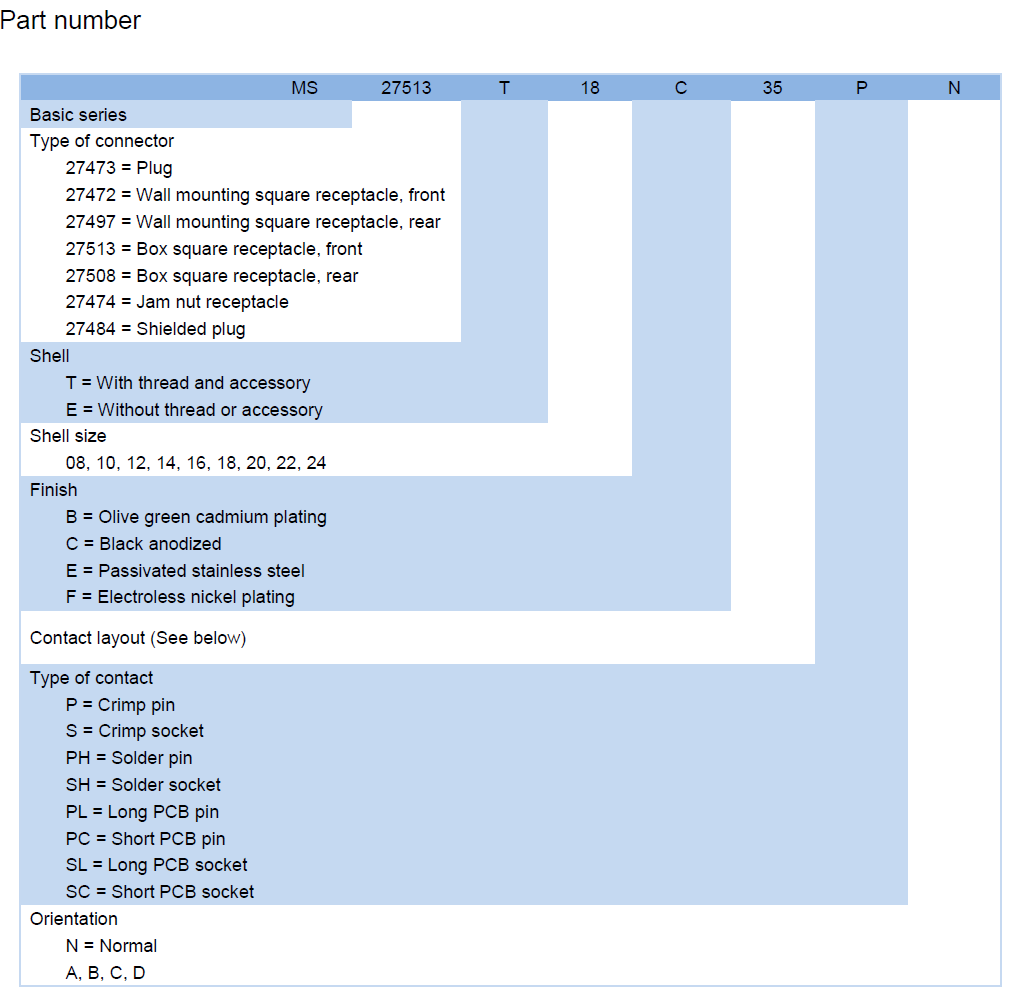
- Your reference is an MS27484T16F35PB connector, and the number reads in blocks: the MS prefix places it in the military standard series, the next block identifies the connector type, a letter says whether the shell carries a thread and accessory, the two digits give the shell size, the following letter gives the finish, the next digits give the contact layout, a contact letter follows, and a final letter marks the variant.
- Connector type codes in the same family: 27473 plug, 27472 wall-mounting square receptacle (front mounting), 27497 wall-mounting square receptacle (rear mounting), 27513 box square receptacle (front), 27508 box square receptacle (rear), 27474 jam-nut receptacle and 27484 shielded plug. If your equipment drawing calls for a panel mount military connector, one of those receptacle codes is what this plug mates to.
- Shell sizes run 08, 10, 12, 14, 16, 18, 20, 22 and 24. The shell size fixes the panel cut-out and the contact capacity, so it is the first block to check against the drawing.
- Shell finishes: B olive green cadmium plating, C black anodized, E passivated stainless steel and F electroless nickel plating. Finish changes corrosion behaviour and appearance, so match it to the environment rather than to what is on the shelf.
- Contact type letters: P crimp pin, S crimp socket, PH solder pin and SH solder socket. Pin and socket must be complementary across the mated pair, so state both halves when you order a plug and receptacle together.
- The trailing letter after the contact code marks the variant and can change hardware details. Order by the complete number rather than by the first blocks, and send the full string if you are matching an existing part.
- Not every variant is listed here.
Ordering and Delivery
- Start with the complete part number, the quantity and the drawing or mating part you are working to. The full number carries the shell size, finish, contact layout and contact type, so nothing has to be guessed.
- Say what you need changed. A different shell size, finish or contact type is a different code, so tell us at enquiry and the offer will match the part you actually fit.
- Order direct. Buying from the MIL-DTL-38999 connector manufacturer keeps one party responsible for the shell, the contacts and the paperwork.
- Quantities are flexible. Flexible MOQs apply and are set per part number and configuration; confirm the figure for your order with your sales contact. Distributors and programme buyers ordering military circular connector wholesale are supplied on the same configuration, so the part does not change between a first build and a production run.
- Delivery is stable across markets. Stable global delivery is supported from our Shenzhen base; confirm the shipping schedule for your quantity and destination when you place the order.
- Terms, packing and after-sales are agreed at quotation. Payment and trade terms are confirmed with the offer, a specific packing method can be requested at enquiry so we can confirm what is possible, and quality issues are handled under the after-sales policy that applies to your order.
Technical Support & Model Matching
Selecting the right connector is rarely a one-line decision. Send us your drawing, part number or a sample, and our engineering team will confirm the matching shell size, contact arrangement, coupling and mounting style, cross-reference discontinued or alternate part numbers, and advise on sealing and flange options for your environment. We also help troubleshoot fit, mating and signal problems, and give installation and commissioning guidance so your line stays up. As a direct manufacturer, our answers come from the people who build the parts — from first enquiry through after-sales support.
Compliance comes first. The part is built to MIL-DTL-38999 Series II, and each connector goes through environmental sealing and high-vibration testing before it leaves us, which is what a life-critical assembly is really buying. Working with a MIL-DTL-38999 connector manufacturer keeps that evidence close to the part: test data and material choices are discussed with the people who built it rather than passed down a distribution chain. Service life is the second reason. A sealed, keyed shell reduces field failures and the maintenance cycles that follow them, and the design stays backward compatible with existing Series II infrastructure, so a repair or a new build can use the receptacles and cable assembly practice already on the platform. Programmes that buy military circular connector wholesale use that continuity to keep one interface across several blocks of equipment. Traceability is the third. Manufacturing is documented, and we support the paperwork a quality team needs — a certificate of conformance and test reports — so the connector can be released against a programme's own quality file instead of being reconstructed afterwards.
FAQ
What does shielded plug mean in this range?
In the MIL-DTL-38999 Series II connector family, the 27484 code denotes a shielded plug. It is the cable-end half of the pair: the metal shell carries shielding continuity and the accessory thread accepts a backshell, while the receptacle is fixed to the panel, box or bulkhead. That shielding is what keeps electromagnetic interference away from the signal path in a dense avionics or communications cable bundle.
Which receptacles does this plug mate with?
It mates with Series II receptacles in the same range: wall-mounting square receptacles for front or rear mounting, box square receptacles, and jam-nut receptacles for a through-panel fit. Any of these can be the panel mount military connector on your equipment. Quote the receptacle code together with the contact layout so the keying and the pin and socket pairing match this plug.
How does the connector cope with salt fog and constant humidity?
The shell is plated and the assembly is sealed at three points: the interface seal between plug and receptacle, the rear wire seals around each wire, and the body seals on the shell. Together they keep salt-laden air and condensation away from the contact interface. It is used on submarine and naval vessel electronics for exactly that reason, and the seal faces should be inspected whenever the wiring is opened for service.
What documentation can be supplied with the connector?
Traceable manufacturing documentation is available: a certificate of conformance and test reports to support your quality file. Those documents are released with the shipment so the part can be accepted against your programme's own records rather than being chased afterwards.
Can I have the same connector in a different shell size or finish?
Yes. The range covers shell sizes 08 through 24 and four finishes: olive green cadmium plating, black anodized, passivated stainless steel and electroless nickel plating. Changing the shell or the finish changes the part number, so send the code you need and we will confirm it against the drawings. Contact type can also be crimp pin, crimp socket, solder pin or solder socket.
What termination options are available for the MS27484T16F35PB connector?
This part is supplied with crimp pin contacts. The same family is built with solder pin and solder socket contacts, and with PCB straight and 90° right-angle terminations for board-level mounting. Crimp is the usual choice for cable assembly work because a contact can be replaced in the field; tell us the termination you need, since it changes the contact code on the order.
Is it suitable for aircraft and avionics systems?
Yes. An aerospace circular connector of this type is used in avionics bays, flight-control runs and engine-monitoring harnesses. What matters in those positions is the shielded shell, the keyed insert and the seal stack working together. For a specific airframe location, confirm shell size, contact layout and finish against the equipment drawing before you order.