Military Circular Connector Overview
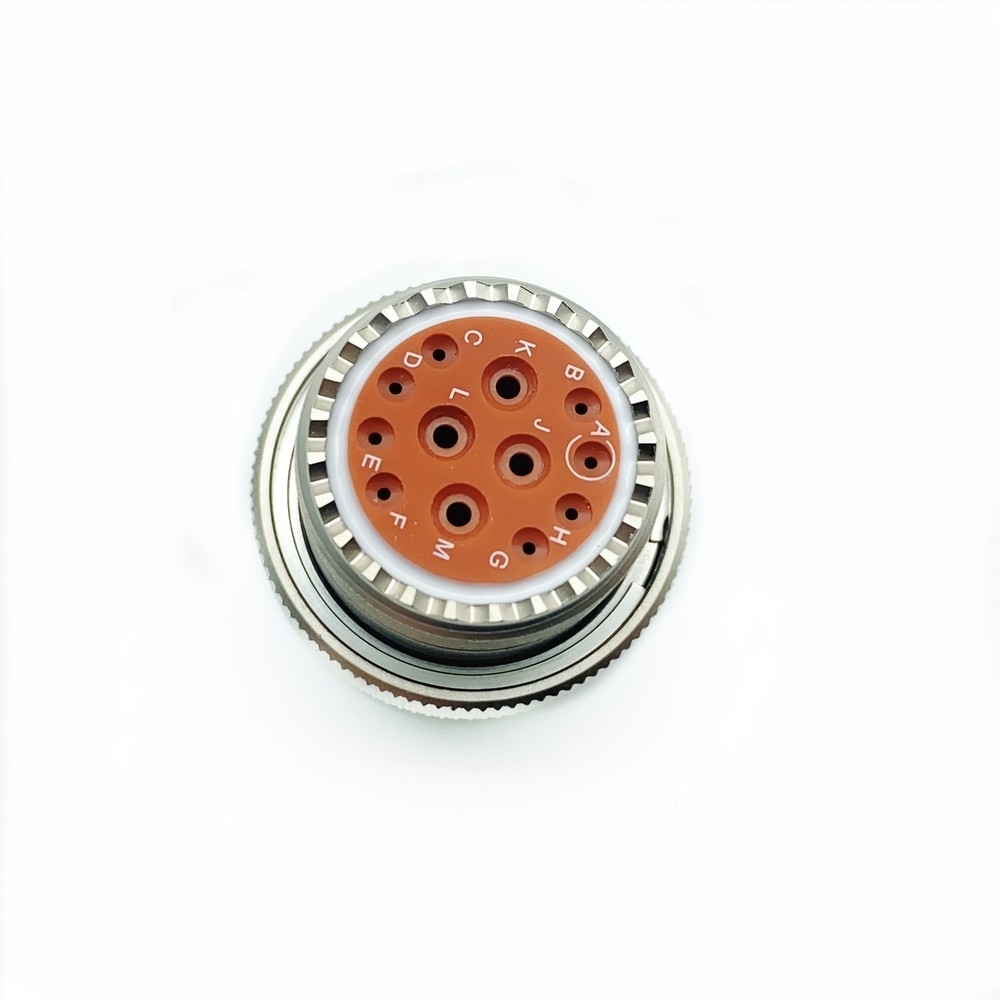
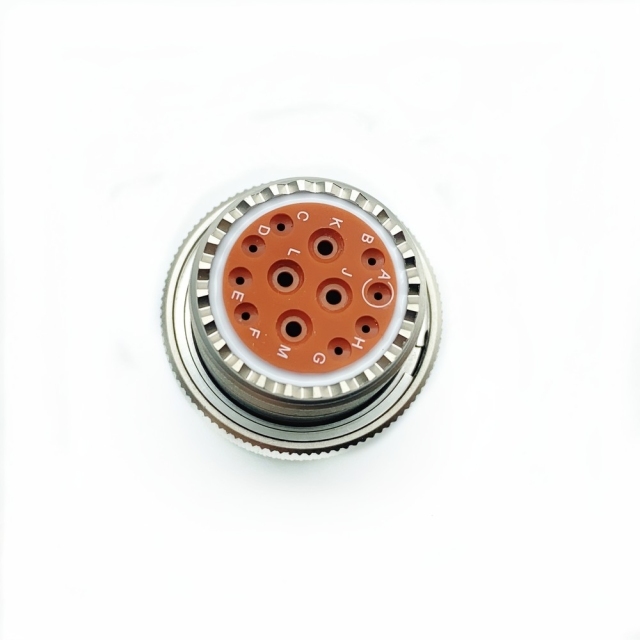
This is the cable-end half of a MIL-DTL-26482 Series II connector: a straight plug in shell size 14, built on the 12 contact layout with socket contacts and normal (N) keying, finished in electroless nickel. The straight body feeds through conduit and cable bundles more easily than a flanged shell, and the coupling ring turns in tight quarters without a wrench. It pairs with the Series II receptacle on the other side of the assembly, so the plug and the panel half are ordered as two separate part numbers.
The MS3476 L14-12 SN connector does its work on the moving side of a wire bundle — the run that leaves a panel, crosses a hinge, or drops down to a sensor on a gearbox or an actuator. A size 14 shell with a 12-way layout sits in the middle of the range: enough ways to carry a control and signal bundle through one shell, small enough that the loom stays flexible and the bend radius stays workable behind a panel or inside a bay.
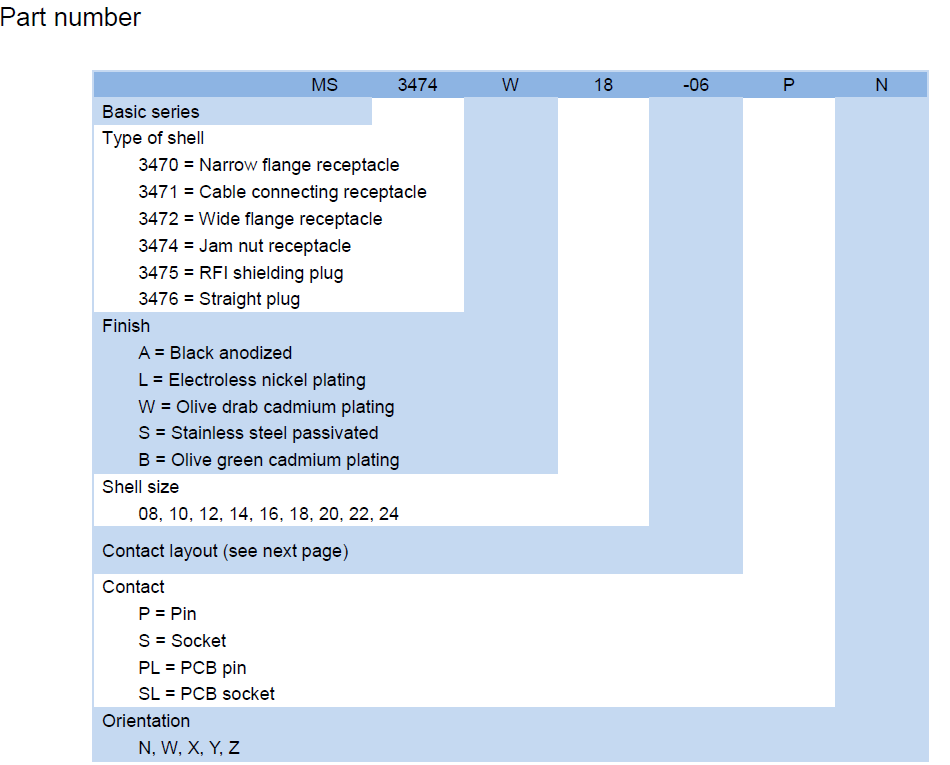
Part Number Breakdown
| Series | MIL-DTL-26482 Series II connector |
| Shell style 3476 | Straight plug |
| Mounting role | Cable-end plug; panel mounting sits on the receptacle half |
| Finish code L | Electroless nickel plating |
| Shell size | 14 |
| Contact layout | 12 |
| Contact code S | Socket |
| Orientation code N | Normal keying |
| Coupling | Bayonet, short turn with detent |
| Other shell styles | 3470 narrow flange, 3471 cable connecting, 3472 wide flange, 3474 jam nut, 3475 RFI shielding |
| Other finishes | A black anodized, B olive green cadmium, S stainless steel passivated, W olive drab cadmium |
| Contact options | P pin, PL PCB pin, SL PCB socket, S socket |
| Orientation options | N, W, X, Y, Z |
Series II Standard & Coupling
MIL-DTL-26482 is the specification that defined the quick-disconnect circular connector still used across military and aerospace platforms; the MIL-DTL-26482 Series II connector is the version most cable assembly drawings call out today. The standard fixes the shell interface, contact spacing and keying, so a compliant plug mates with a compliant receptacle of the same shell size and layout even when the two halves come from different production runs. Coupling is by a bayonet military circular connector ring: push the halves together, turn the ring through a short arc and the detent locks with an audible click. In a crowded avionics rack or a vehicle bay where a technician is working one-handed, that counts for more than it sounds.
If your drawing instead specifies a threaded coupling military connector, check the interface before you substitute — the coupling styles are not interchangeable, and a threaded shell will not latch onto a bayonet receptacle. On this plug the thread at the rear of the shell is a backshell thread, used for a straight or elbow backshell and the cable strain relief that goes with it. Send us the receptacle part number from the other side of the cable assembly and we will confirm the pairing before anything is built.
Shell, Contacts & Sealing
- Shell and finish: the body is a machined metal shell with the L finish, electroless nickel — an even plated layer that resists corrosion and keeps the shell conductive across the interface.
- Contacts: the socket contacts are plated gold over nickel, a combination chosen for low contact resistance and stable signal transfer through repeated mating.
- Sealing: an O-ring at the interface and a grommet at the rear close the connector against moisture, dust and fluid splash; the grommet grips each wire as the contact is seated, so the back of the shell stays closed.
- Shielding: metal-to-metal contact between the coupled shells carries the screen across the joint. If your cable assembly needs a screened backshell, say so when you specify, because it changes what sits behind the plug.
- Backshell options: straight and elbow backshells are available for different cable routing, and the right one takes the pull of the cable off the contact terminations.
- Built in-house: as a MIL-DTL-26482 connector manufacturer we machine, plate and assemble under one roof, so plating thickness and insert alignment are checked at the source rather than at a subcontractor's gate.
- One tooling set: MS3476 connector wholesale batches and single repair plugs come off the same tool and the same drawings, so an MS3476 L14-12 SN connector bought next year engages its receptacle the way the one in your current build does.
Vibration & Shock Performance
Every military circular connector supplier will tell you its shell is vibration resistant. The useful question is what actually holds a connection together on a moving platform: the coupling detent, the retention of each contact inside the insert, and the way the grommet grips every wire behind its contact. When a loom is bouncing over rough ground or shaking in an engine bay, those three points take the load — and a plug that loses any one of them surfaces later as an intermittent fault that costs far more to trace than the connector cost to buy.
That is the environment this plug is drawn for. As a ruggedized aerospace circular connector it is expected to stay seated through shock loads and continuous vibration, with the backshell carrying the cable's weight and the bayonet ring providing a positive lock rather than relying on friction alone. Match the backshell and clamping arrangement to the cable diameter you actually run: on vibration-heavy installations most field failures begin with a cable that was never properly strain-relieved, not with the contacts. On tracked vehicles and rotorcraft, put the plug on the same inspection interval as the rest of the wiring loom.
Product Advantages
Compliance you can point to: the plug is built by a MIL-DTL-26482 connector manufacturer to the published Series II interface rather than to a loose military-style description, so your drawing has a specification to reference. Each connector is checked for sealing and vibration performance before it leaves the line. That is the practical difference between a part that passes a first article and one that keeps passing after a year in service — fewer intermittent faults, fewer harnesses pulled out of vehicles to chase a connector that looked fine on the bench, and a lower cost of ownership across the platform's life than a part replaced at every depot visit. Direct from the maker: the plugs are machined, plated and assembled in our own plant in Shenzhen, so MS3476 connector wholesale programmes are supplied without a distributor layer between the drawing and the part. If your programme needs a variant that is not covered here, send a photo and the key dimensions and our engineering team will tell you what can be built.
Critical Applications
- Armoured and tactical vehicles: wiring runs through the hull, turret and communications bays, where shock from rough ground and gunfire is normal service rather than an exception.
- Aircraft and avionics: flight control, engine control, navigation and communications runs on fixed-wing and rotary platforms; the straight body suits bundles routed behind panels and through equipment bays.
- Naval and shipboard systems: communication, radar and weapons-control cabling, where salt air and constant hull movement are harder on a connector than the operating temperature.
- Unmanned systems: data links and power on UAV and UUV platforms, where a ruggedized aerospace circular connector has to survive launch, recovery and long gaps between inspections.
- Test and ground support equipment: GSE cable assemblies and test benches where connectors are mated far more often than in service, so contact wear and coupling durability become the limiting factor.
- Satellite and space systems: weight, vacuum and radiation drive the choice here, and suitability depends on the qualification level your programme requires — confirm that with us before the design freezes. These connectors are chosen for proven compliance, unmatched durability in harsh defense operations, and mission-critical reliability that minimizes the risk of connection failure. Their high reliability helps reduce lifecycle costs through lower maintenance and replacement expenses. You partner with a certified manufacturer committed to quality and military standards. As a direct manufacturer of military-grade circular connectors, we remove middleman markups to support competitive volume pricing for aerospace and defense procurement. Every connector undergoes rigorous environmental sealing and high-vibration testing to support strict compliance with international military standards, and we support flexible order quantities and stable global delivery.
Mating & Installation
- Check the interface first — the receptacle must be shell size 14 and the same 12 contact layout. A plug that looks right but carries a different layout will not seat, however carefully it is aligned.
- Confirm the contact pairing — this plug carries socket contacts (code S), so the mating receptacle should carry pins for the same layout. Read the receptacle's contact code, not just its shell size.
- Terminate and load the contacts — crimp or solder according to the contact style you specify, seat each one fully with the correct tool, and give every wire a light pull to prove retention before the plug goes into service.
- Couple the plug — line up the keyway on normal (N) orientation, push the halves together and turn the bayonet military circular connector ring until the detent drops in. Never force a ring that stops early; back it off and check the keyway.
- Fit the backshell — slide it over the cable before termination, then tighten it onto the rear thread so the clamp takes the load. Teams used to a threaded coupling military connector sometimes try to screw the coupling ring itself; on a Series II plug the ring turns a short way and then locks.
- Inspect and prove the circuit — check for a fully seated ring, no visible gap at the interface, and correct continuity and pin-out before the wiring assembly is released.
- Record the build — note the plug number, the receptacle it mates with and the backshell used. It is the fastest route to a correct reorder or to diagnosing a fault on the same run.
Ordering & Delivery
- Complete part number: finish, shell size, contact layout, contact type and orientation are all part of the number. Change the L finish to a W and it becomes a different plug, so order on the full string rather than on shell size alone.
- Flexible MOQs: order quantities are set per item, so a repair requirement and a production release can both be handled. Tell us the annual volume and the first delivery you need when you enquire.
- Stable global delivery: orders ship from Shenzhen to customers across Europe, Russia, the Middle East and beyond, and production runs are planned so repeat releases arrive on schedule.
- Supply scope: as a military circular connector supplier we cover the plugs, receptacles, contacts and backshells around this part, so the mating half and the accessories can travel on the same order.
- Volume and repair quantities: MS3476 connector wholesale requirements and small repair orders are quoted on the same part number, so nothing changes on the drawing when the quantity does.
- Payment and terms: agreed at quotation — FOB, CIF or CNF are the usual bases, and most payments run by T/T with a deposit on order and the balance before shipment. Confirm what applies to your order.
- Packing: plugs are bagged and boxed for export as standard. If your line needs a particular pack format, labelling or kitting, ask your sales contact what can be arranged and how it affects the order.
- Samples, timing and after-sales: ask your sales contact about sample availability and the current production schedule for the quantity you need. Quality issues reported within one year of delivery are handled under our after-sales policy, and your sales contact can confirm the terms that apply.
Technical Support & Model Matching
Selecting the right connector is rarely a one-line decision. Send us your drawing, part number or a sample, and our engineering team will confirm the matching shell size, contact arrangement, coupling and mounting style, cross-reference discontinued or alternate part numbers, and advise on sealing and flange options for your environment. We also help troubleshoot fit, mating and signal problems, and give installation and commissioning guidance so your line stays up. As a direct manufacturer, our answers come from the people who build the parts — from first enquiry through after-sales support.
FAQ
What does MIL-DTL-26482 Series II actually specify?
It is the military specification behind the quick-disconnect circular connectors used across vehicle, aircraft and shipboard wiring. Series II fixes the shell interface, contact spacing and keying, and it is the version most current assembly drawings call out. The shell size, contact layout, keying and finish in this part number are all read against that standard.
Does this plug have pins or sockets?
Socket contacts, code S, are fitted in this plug — the usual arrangement on a cable-end plug, because the pins stay protected in the receptacle when the halves are separated. When you order the mating receptacle, specify pin contacts for the same 12-way layout. If you are matching an existing cable assembly, read the receptacle's contact code before ordering, because the MS3476 L14-12 SN connector cannot be paired with another socket half.
How is this different from a threaded coupling military connector?
Mainly in how it locks. A threaded coupling military connector is screwed on over several turns and relies on thread engagement to stay put, while this plug uses a bayonet ring that travels a short arc and then drops into a detent — faster to mate in a crowded bay and easier to confirm by feel. Neither style replaces proper strain relief: the backshell carries the cable load on both.
Will it hold up on a tracked vehicle or in an engine bay?
The shell is built for the shock and continuous vibration those environments produce, which is why it is used on vehicle, aircraft and naval wiring assemblies. What decides long-term survival is the installation: a backshell that clamps the cable, contacts seated with the right tool, and the plug included in the cable assembly inspection interval. As a ruggedized aerospace circular connector it is also sealed at the interface against moisture and dust; if your programme adds salt spray or fluid exposure, confirm the finish and sealing class against your own specification.
What does the L finish give me, and can I have a different one?
L is electroless nickel: an evenly plated layer over the shell that resists corrosion and keeps the shell conductive for shielding. The family also covers black anodized (A), olive drab cadmium (W), olive green cadmium (B) and stainless steel passivated (S). Cadmium finishes are restricted on some programmes, so confirm which finish your drawing calls for before ordering — changing the finish changes the part number.
How do I know the bayonet coupling is fully locked?
The ring drops into a detent with a click and a short final travel, and the shells sit metal-to-metal with no visible gap at the interface. Turn the ring back by hand after coupling: a locked bayonet military circular connector will not begin to release without the proper action. If the ring stops short, do not force it — separate the halves, check the keyway and contact alignment, and try again.